


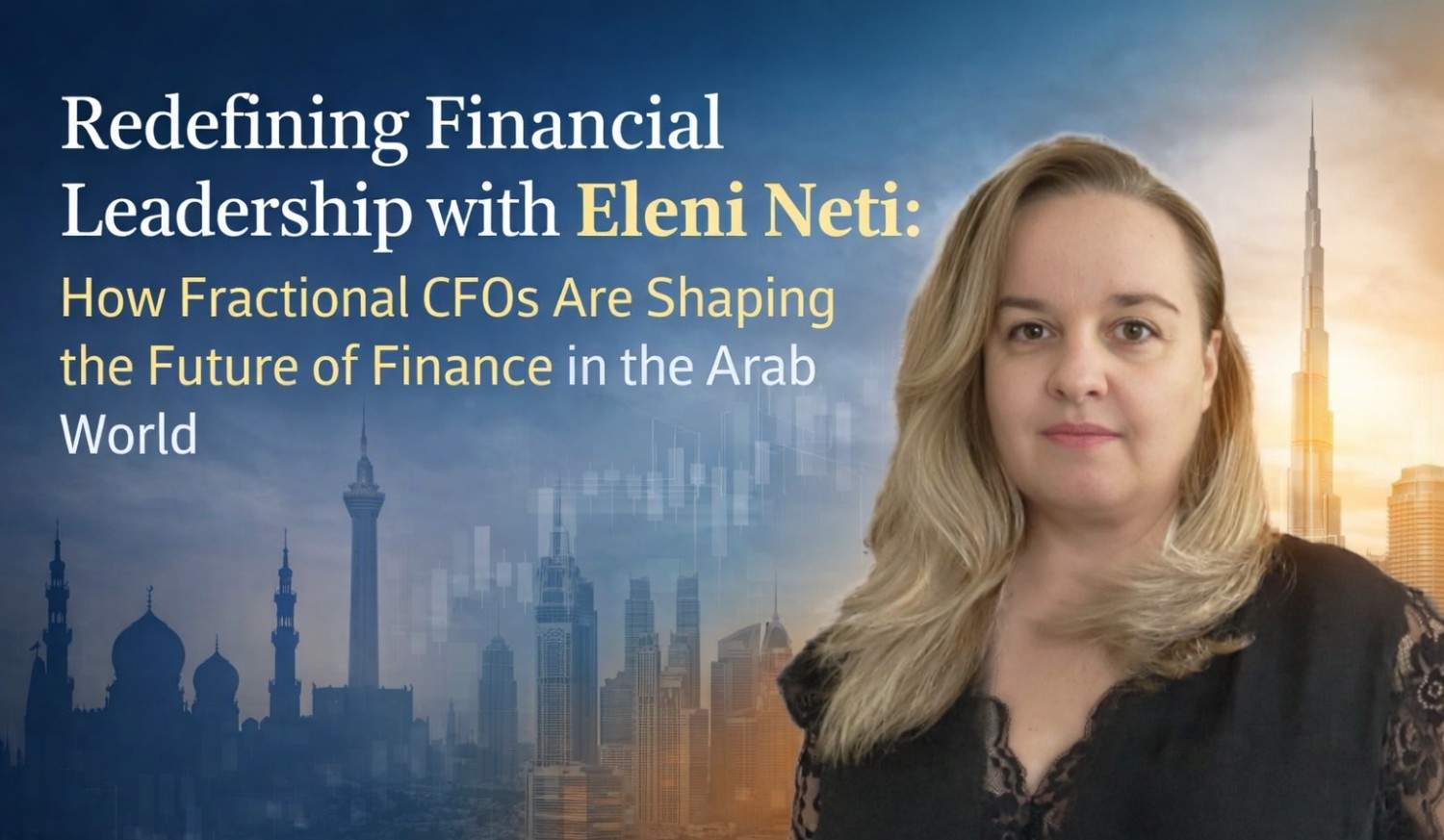
In a rapidly evolving business landscape, the role of finance leadership is undergoing a fundamental transformation. No longer limited to reporting and compliance, today’s finance leaders are expected to be strategic partners, value creators, and drivers of sustainable growth. Across the Arab world particularly in markets such as the UAE and Saudi Arabia this shift is accelerating in line with ambitious national visions and economic diversification agendas.
In this exclusive interview with UAE Times, we speak with a seasoned Fractional CFO and Strategic Advisor Eleni Neti , who is at the forefront of this change. She shares insights into her journey, the challenges of modern finance leadership, the evolution of the finance function in the region, and her long-term vision for strengthening financial leadership across the Arab world.
What inspired you to become a Fractional CFO and Strategic Advisor, and to focus your work in the finance industry?
What inspired me was a pattern I repeatedly observed across companies of all sizes. Whether it was a startup, a fast-growing business, or a well-established organization, many only required senior financial leadership at specific moments such as expansion, acquisition, transformation, restructuring, or strategic reset. Others needed this expertise but could not justify the cost of a full-time CFO.
The choice was often between having no CFO support at all or building a heavy, full-time structure that did not truly align with the organization’s real needs.
I saw a clear gap in flexibility. Through the fractional CFO model, I provide financial and strategic guidance precisely when it matters most, without adding unnecessary cost, hierarchy, or complexity. This allows organizations to access experienced leadership during critical phases while remaining agile and focused.
My vision goes beyond traditional CFO services. As a CFO and coach, I work to transform the finance function into a true strategic partner. My focus is on improving financial performance, strengthening leadership, and supporting innovation and digital transformation. Ultimately, the goal is to align numbers with strategy and vision in order to drive sustainable value and scalable growth.
At the same time, finance professionals are too often positioned as executors rather than strategic partners. I believe finance leaders at any level should think like business owners: commercially aware, forward-looking, and deeply connected to value creation. While the business world is moving fast, parts of the finance profession remain outdated. My mission is to help transform the finance workforce into trusted partners in growth, transformation, and long-term success.
What key obstacles or challenges have you encountered on this journey, and what lessons have you learned as a leader in the finance industry?
One of the most consistent challenges has been changing how the finance function is perceived and how it operates. In many organizations, finance is still primarily focused on reporting, compliance, and historical results, rather than supporting future decisions and strategy. This mindset is rooted in traditional structures and training that prioritize control and accuracy more than agility and insight.
One of the most important lessons I have learned is that the biggest barrier in modern finance is not technical skill, but mindset. Progress often requires unlearning letting go of linear processes and being open to new ways of thinking, analyzing, and partnering with the business. With the rise of digital transformation, AI, and new business models, this shift is no longer optional. For many professionals, changing their mindset is more challenging than learning new tools.
This directly impacts finance teams. A central part of my work is helping teams move from a “doing” role to a “thinking” role from simply closing the books to interpreting what the numbers truly mean. From controlling costs to helping create value. When finance professionals begin to think like business owners, the impact on the organization is both significant and long-lasting.
Another challenge has been external skepticism particularly around the fractional leadership model and, at times, gender bias at senior levels. These experiences have reinforced my belief that leadership authority today does not come from title or position. It comes from mindset, behavior, and the ability to build trust quickly by delivering real value.
Ultimately, true impact is achieved when finance becomes an active part of the strategic and operational core of the organization.
From your perspective, how is the finance sector in the Arab world evolving, and what major trends do you anticipate in the coming years?
The finance sector in the Arab world is undergoing a clear and meaningful shift. Finance is moving away from a narrow focus on control and compliance toward a more strategic, value-creating role. While strong governance and reporting remain essential, finance is now expected to actively support strategy, investment decisions, and long-term resilience.
This evolution is strongly influenced by national transformation agendas, particularly in markets such as the UAE and Saudi Arabia. These visions place finance at the center of economic diversification, innovation, and sustainable growth translating ambition into measurable outcomes.
Technology is further accelerating this transformation. Automation, real-time analytics, and AI are raising expectations. Finance is no longer about reporting what happened, but about helping leaders understand what comes next through insights, scenario planning, and informed decision-making.
At the same time, regulatory frameworks across the region are maturing and aligning with global standards. This strengthens the role of finance in building trust, transparency, and investor confidence.
Beyond systems and tools, the most important shift is cultural. The future belongs to finance leaders who act as true business partners. Looking ahead, I see two clear trends: finance leaders increasingly operating at the intersection of finance, strategy, and operations, and organizations continuing to adopt more flexible leadership models including fractional and interim roles to access senior expertise during periods of growth and transformation.
Sustainability and ESG integration are also becoming central to the finance agenda in the region. Increasingly, finance leaders are expected to embed green economy initiatives directly into financial planning, investment evaluation, and performance measurement. This means moving beyond ESG as a compliance or reporting exercise, and instead linking sustainability objectives to capital allocation, risk management, and long-term value creation. In markets such as the UAE and Saudi Arabia, where national strategies emphasize sustainable growth and responsible investment, finance plays a critical role in translating ESG ambitions into measurable financial outcomes.
The future of finance in the Arab world will be defined by adaptability, partnership, and impact.
What are your long-term goals as a Fractional CFO and Strategic Advisor, and how do you envision your contribution to the finance industry across the Arab region?
My long-term goal is to help raise the benchmark for financial leadership across the Arab region by making strategic, integrated finance expertise more accessible and more impactful. I see the fractional CFO model evolving from an alternative service into a trusted and established leadership structure for ambitious and fast-moving organizations.
My contribution is focused on strengthening the strategic role of finance and positioning it as a driver of growth and execution. A critical part of this journey is developing finance teams and future leaders through coaching ensuring organizations build long-term capability, not just short-term results. Finance functions must think commercially, take ownership, and consistently align numbers with vision.
Equally important is leadership agility. In a region defined by rapid growth and continuous transformation, financial flexibility is becoming a decisive strategic advantage. By combining experience, adaptability, and strategic insight, I aim to support organizations and finance professionals in navigating complexity and unlocking sustainable growth.
As businesses across the Arab world navigate unprecedented transformation, the finance function is emerging as a cornerstone of strategic success. Leaders who can bridge numbers with vision, and insight with execution, will shape the region’s next phase of growth. Through innovative models such as fractional CFO leadership, the future of finance is becoming more agile, inclusive, and impact-driven setting a new standard for how financial leadership creates value in a rapidly changing world.

