



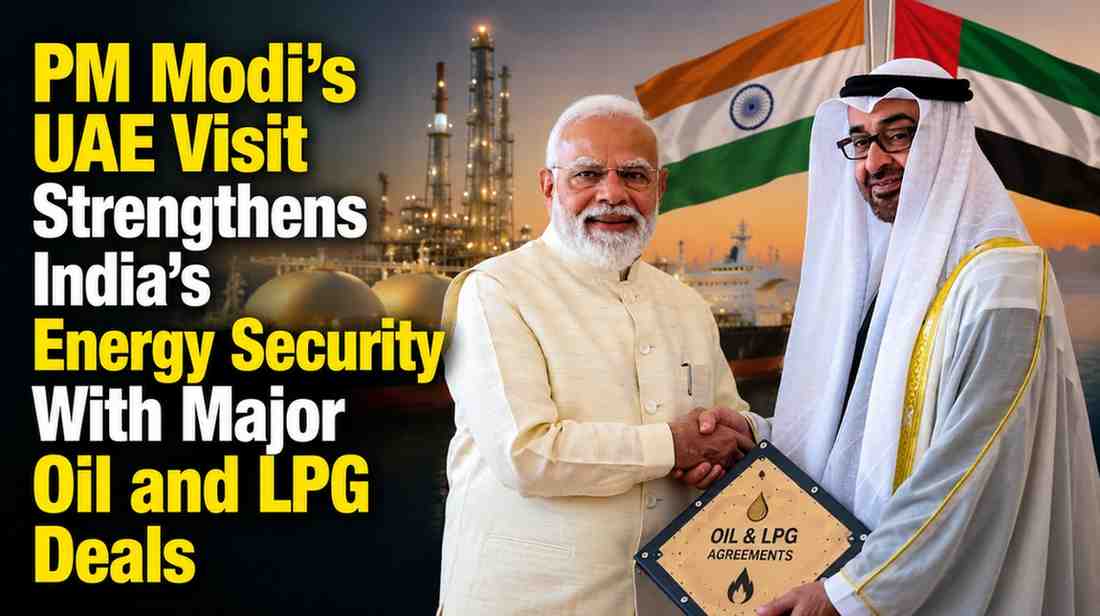
India Strengthens Energy Future With Strategic Oil and LPG Agreements During Modi’s UAE Visit
Prime Minister Narendra Modi’s latest visit to the United Arab Emirates has delivered a significant boost to India’s long-term energy security, with both nations signing key agreements related to strategic petroleum reserves and liquefied petroleum gas (LPG) supplies. The high-level talks in Abu Dhabi focused heavily on protecting India’s energy future amid rising geopolitical tensions and uncertainty in global oil markets.
During the visit, PM Modi held discussions with UAE President Sheikh Mohamed bin Zayed Al Nahyan, where both sides agreed to deepen cooperation across energy, trade, defence, infrastructure, and advanced technology sectors. However, the biggest focus remained on securing stable and long-term energy supplies for India.
India imports nearly 85 percent of its crude oil requirements, making energy security one of the country’s most important strategic priorities. Any disruption in global oil supply routes or sudden spikes in international crude prices can directly affect India’s economy, fuel costs, transportation sector, and inflation levels.
One of the most important agreements signed during the visit involves India’s strategic petroleum reserves. Strategic reserves are emergency crude oil stockpiles stored by governments to handle supply disruptions during wars, geopolitical crises, or global market instability.
India currently operates strategic petroleum reserve facilities in locations such as Mangaluru, Visakhapatnam, and Padur. The UAE’s state-owned Abu Dhabi National Oil Company (ADNOC) already stores crude oil at India’s Mangaluru facility under an earlier agreement signed between the two countries. The latest pact is expected to expand this arrangement further, increasing India’s emergency oil storage capacity.
The agreement becomes especially important due to growing tensions in West Asia and concerns surrounding the Strait of Hormuz, one of the world’s most critical oil shipping routes. A large percentage of India’s crude oil imports pass through this region, making any instability there a major concern for Indian energy planners.
By expanding strategic oil reserves with UAE cooperation, India gains an important safety cushion against global supply shocks. During emergencies, these reserves can help stabilise domestic fuel availability and reduce panic buying or sudden price surges.
Another major outcome of Modi’s UAE visit was the agreement on long-term LPG supply. The UAE currently supplies nearly 40 percent of India’s LPG requirements, making it India’s largest LPG supplier.
The new agreement is expected to ensure stable and uninterrupted LPG availability for Indian households and industries. This is especially significant because India’s demand for clean cooking fuel has grown rapidly under government welfare programs such as the Pradhan Mantri Ujjwala Yojana, which expanded LPG access across millions of homes in rural and low-income communities.
Long-term LPG contracts also help India negotiate better prices and reduce dependence on volatile international spot markets. Stable pricing agreements can help protect Indian consumers from sudden increases in cooking gas prices caused by global market fluctuations.
Experts say the timing of the agreements is highly strategic. The global energy market remains under pressure due to geopolitical tensions involving Iran, concerns over maritime security, and uncertainty surrounding oil shipping routes. India is therefore actively seeking reliable long-term partnerships with stable energy-producing countries like the UAE.
The UAE has emerged as one of India’s closest strategic partners in recent years. Beyond oil and LPG cooperation, both countries are also expanding collaboration in renewable energy, LNG supplies, defence manufacturing, shipping infrastructure, artificial intelligence, and investment projects.
During the visit, Abu Dhabi also committed around $5 billion in investments in Indian infrastructure and financial sectors. These investments are expected to support India’s economic growth while strengthening bilateral trade ties between the two countries.
Officials also discussed cooperation in renewable energy and electricity grid connectivity. UAE clean energy company Masdar has already partnered with Indian authorities on large renewable energy projects, including a proposed 60 GW renewable initiative in Rajasthan.
Analysts believe India’s growing partnership with the UAE reflects a broader strategy of diversifying energy sources while strengthening strategic ties with Gulf nations. Depending heavily on limited suppliers can increase risks during international crises, so expanding trusted partnerships improves long-term energy resilience.
PM Modi’s UAE visit also highlighted the importance of the India-Middle East-Europe Economic Corridor (IMEC), which aims to improve trade connectivity between India, the Gulf region, and Europe. The corridor is expected to enhance transportation, logistics, and energy cooperation between participating countries.
India’s rapidly growing economy will continue increasing demand for crude oil, natural gas, and clean energy over the next decade. Ensuring stable supply chains and long-term partnerships will therefore remain critical for sustaining industrial growth, transportation networks, manufacturing, and household energy needs.
Also Read: Abu Dhabi to Build Massive Sphere Entertainment Venue on Yas Island
The agreements signed during PM Modi’s UAE visit are being viewed as a major diplomatic and economic achievement that strengthens India’s energy security while deepening one of its most important strategic partnerships in the Gulf region.

