


[ad_1]
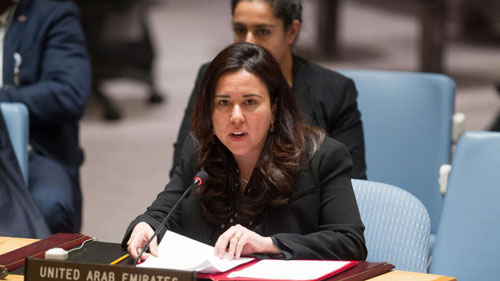
Lana Zaki Nusseibeh, UAE Ambassador to the United Nations, has sharply criticized the Islamic emirate’s restrictions on Afghan women and girls.

Speaking at the UN Security Council’s open debate on women, peace and security on Thursday, Nusaybe said it was “unacceptable” that Afghan girls were still not allowed to attend secondary school.
“It’s been almost 400 days since girls in Afghanistan were banned from secondary school, no if, or, but, the UAE considers this restriction and many others that have been in place since the Taliban took over as totally unacceptable,” Nusseibeh said on Women, told the UN Security Council at its annual meeting on peace and security.
“This enables gender segregation,” Nusebe told the UN Security Council. “We find ourselves still fighting the misconception that women and girls are seen as victims or survivors rather than agents of change,” said the UAE’s Nusseibeh.
Meanwhile, in an interview with Turkish news media, a spokesman for the Islamic Emirate said that schools for girls from the sixth grade and above will open after the issue is dealt with and procedures are established.
“Some schools from Years 6 to 12 are closed so that their curriculum is more accurate and women’s physical safety and their dignity and virginity will be better protected, and due to the concerns of some families, and because Afghanistan is a country with Countries with issues of culture, tradition, sensitivities and honor, are taking appropriate steps to address them, and that is also allowed,” he said.
At the same time, the United Nations has also said that denying education violates the human rights of women and girls and makes them more vulnerable to violence, poverty and exploitation.
“Afghanistan: Denying education violates the human rights of women and girls, making them more vulnerable to violence, poverty and exploitation. All students must be allowed to exercise their right to education,” the UN tweeted.
“The school has been closed to us for over a year, and I ask the Islamic Emirate to reopen the school for us,” said Sohella, a student.
Meanwhile, the Friends of Afghanistan Women’s Group from 27 countries expressed deep concern over “the Taliban’s increasing weakening of respect for the human rights and fundamental freedoms of Afghan women and girls,” including restricting access to women’s and girls’ education.
Meanwhile, during an open debate at the UN Security Council on women, peace and security, some countries called for the lifting of restrictions on Afghan women.
Norway’s ambassador to the United Nations said efforts were being made to promote direct exchanges between Afghan women and the Islamic emirate.
“Afghan women continue to ask the international community to create platforms for them to engage directly with the Taliban, and we will continue to find safe spaces for them,” said Mona Juhl, Norway’s permanent representative to the United Nations.
“Having a conference like this and expressing support for Afghan women’s rights is absolutely inspiring in the current situation Afghan women find themselves in, and shows that the world has not forgotten about Afghan women. But the commitment to defend and support Afghan women announced by the international community is met with Afghan women will not progress until they are truly delivered,” said women’s rights activist Mariam Marouf Alwin.
During the debate, China’s permanent representative to the United Nations expressed hope that the rights and interests of Afghan women will be protected.
“China hopes that their basic rights will be guaranteed, their interests will be guaranteed, they will be organically integrated into the country’s economic and social life, and they will become an important force in the country’s peace and reconstruction,” said Geng Shuang, deputy permanent representative. China to the United Nations.
At the Security Council meeting, U.S. Ambassador Linda Thomas-Greenfield said that the U.S. has formed a U.S.-Arab consultation mechanism.
“The United States established the U.S.-Afghanistan Consultation Mechanism. This mechanism systematically engages various voices in Afghanistan, especially women and civil society leaders, so their perspectives are incorporated into our policy discussions,” U.S. Ambassador to the United Nations Linda Thomas – Greenfield said.
Ambassador Ravindra, Deputy Permanent Representative of India, called for respect for the rights of Afghan women and minorities.
“Complete immunity has been obtained and there is no threat to Afghanistan. Thousands of courts have been established in various provinces and regions across the country to serve the masses and protect their rights. Anyone who has questions about their rights should go to the courts, where their rights are will be guaranteed,” said Zabiullah Mujahid, spokesman for the Islamic emirate.
[ad_2]
Source link

