


[ad_1]
Abu Dhabi National Oil Company (Adnoc) and Dubai Supply Authority (DUSUP) signed a landmark gas sales agreement on Friday.
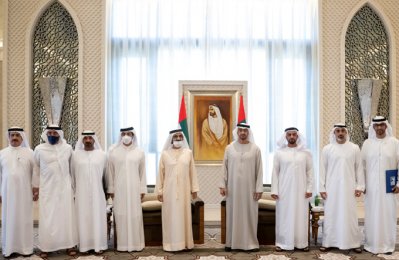
The signing of the agreement was witnessed by His Highness Sheikh Mohamed bin Zayed Al Nahyan, President of the UAE, and His Highness Sheikh Mohammed bin Rashid Al Maktoum, Vice President, Prime Minister and Ruler of Dubai.
According to the agreement, Adnoc will supply natural gas to DUSUP, which will replace clean coal for the power generation of Dubai Electricity and Water Authority (DEWA) IPP (Independent Power Producer) Hassyan Power Complex, further reducing carbon emissions in the power generation process. Wam news agency reported , which supports the UAE’s strategic initiative to achieve net-zero emissions by 2050 and its plans to generate electricity from clean sources of energy.
The agreement was signed in Qasr Al Watan by Sheikh Ahmed bin Saeed Al Maktoum, Chairman of Dubai Supreme Energy Council and Director General of DUSUP, and Dr. Sultan Ahmed Al Jaber, UAE Minister of Industry and Advanced Technology and Adnoc Managing Director. CEO.
Sheikh Ahmed bin Saeed said: “This agreement supports the vision and directives of the wise leadership to transform Dubai into a carbon-neutral economy by 2050 and provide 100% of Dubai’s total power generation capacity From Clean Energy. The agreement further strengthens energy cooperation between Abu Dhabi and Dubai, building on the foundations originally laid in 1998 and consolidated over the years to expand the breadth and depth of our energy relationship.
“While many countries around the world are returning to coal due to geopolitical uncertainty and energy price volatility, the UAE is delivering on its commitment to decarbonize its power sector.”
Dr Al Jaber said that following the direction of the UAE’s wise leadership, ADNOC is working to harness Abu Dhabi’s abundant natural gas resources to meet the world’s growing demand for this vital transition fuel and enable a responsible energy transition. This landmark agreement will significantly reduce emissions from electricity generation at the Hassyan Power Complex, directly supporting the UAE’s 2050 Net Zero Emissions Strategic Plan.
“Working closely with our customers and partners, ADNOC will continue to expand our gas capacity to meet our strategic goals of decarbonizing our energy and power systems, ensuring the UAE’s gas self-sufficiency and driving long-term and sustainable growth in the UAE,” he said. added.
Adnoc’s integrated gas master plan links every part of the gas value chain to ensure a sustainable and economical supply of gas to meet the growing demand of the UAE and international markets. The plan includes applying new methods and technologies to enhance existing oil fields and competitive natural gas recovery rates, as well as exploiting untapped resources and leveraging innovations to drive sustained emissions reductions.
Domestic natural gas is more commercially competitive than imported coal or natural gas, and its use as a substitute for coal in power generation will support economic growth while reducing emissions.
Adnoc is a responsible supplier of reliable low carbon energy. In addition to expanding its natural gas business, Adnoc is growing its new energy business to capitalize on opportunities in the hydrogen and renewable energy sectors, while embracing the energy transition as its business decarbonises and continues to help meet global energy demand.
Hassyan Power Complex was originally built as a dual-fuel power plant capable of running at full capacity on natural gas or clean coal throughout the day, but has been converted to run on natural gas only. The Hassyan Power Complex currently has a net generating capacity of 1,200 megawatts (MW). A further 600 MW (net) is planned for the fourth quarter of 2022 and another 600 MW (net) by the third quarter of 2023.
The complex is an important addition to DEWA’s power generation projects, including the Jebel Ali Power and Desalination Complex, Al Aweer Power Station Complex, Mohammed bin Rashid Al Maktoum Solar Park, the largest single-site solar park in the world, with a planned capacity of 5,000 Terabytes by 2030 Watt, Hatta’s green hydrogen and hydroelectric power plant.
[ad_2]
Source link

