


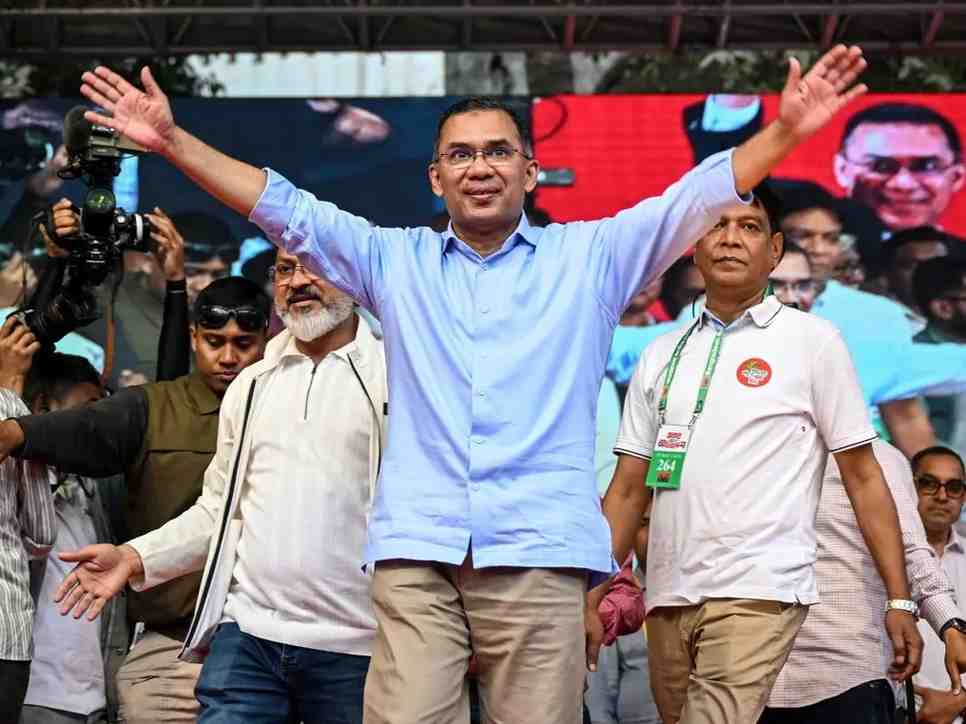
Historic Bangladesh Election Sees BNP Poised for Major Victory, Jamaat Falls Behind
Dhaka, Bangladesh — In a historic political realignment, the Bangladesh Nationalist Party (BNP) is on course for a commanding parliamentary victory in the nation’s first general election since the 2024 mass uprising that ousted long-time Prime Minister Sheikh Hasina. Early counting indicates the BNP has secured 120 seats outright and is leading in another 55 constituencies—more than enough to form the next government.
The election marks the political resurrection of a party that spent years in the political wilderness under Awami League dominance. Tarique Rahman, the son of late BNP founder Khaleda Zia and the party’s de facto leader, is poised to become Bangladesh’s next prime minister, having already won from both Dhaka-17 and Bogura-6 constituencies.
BNP’s Surge in a Transformed Political Landscape
The BNP’s resurgence reflects deep public appetite for change following the dramatic events of 2024, when the July Uprising—a mass protest movement—toppled Sheikh Hasina’s 15-year rule and forced her into exile. The subsequent interim administration, led by Nobel laureate Muhammad Yunus, oversaw preparations for Thursday’s parliamentary polls.
Tarique Rahman’s campaign focused on three core themes:
National unity — Healing divisions exposed by years of political polarization
Economic renewal — Addressing inflation, employment, and growth challenges
Institutional reform — Restoring trust in public institutions
The BNP leader’s personal victories in two constituencies consolidate his authority and position him as the undisputed architect of the party’s electoral resurgence.
However, the victory comes with a notable caveat. Voter turnout stood at approximately 47 per cent—significantly lower than the 80-plus per cent participation seen in Bangladesh’s fiercely contested previous elections. Analysts attribute this to:
Voter fatigue following years of political turbulence
Disillusionment with traditional political formations
Skepticism over electoral processes after prolonged instability
Security concerns among minority communities
Jamaat-e-Islami Trails as Junior Partner
The Islamist Jamaat-e-Islami and its allies, widely expected to emerge as the principal opposition, have underperformed relative to projections. According to partial tallies, Jamaat and affiliated candidates are currently positioned to secure between 38 and 68 seats—a distant second to the BNP’s commanding parliamentary presence.
Shafiqur Rahman, Jamaat-e-Islami’s leader, acknowledged the electoral setback with notable restraint. In media statements, he signaled that his party would pursue “positive politics” as an opposition force rather than resort to obstructionism—a significant departure from the confrontational posture that has historically characterized Bangladesh’s parliamentary politics.
The Absent Giant: Awami League Banned
Perhaps the most striking feature of the 2026 election is what—and who—is not on the ballot.
The Awami League, Sheikh Hasina’s party that dominated Bangladesh politics for over a decade, was barred from contesting following the 2024 uprising. Its iconic boat symbol—a fixture on Bangladeshi ballots for three decades—was absent from polling stations nationwide.
Hasina, speaking from self-imposed exile, condemned Thursday’s vote as a “well-planned farce,” alleging that voter turnout was artificially suppressed and that her party’s exclusion fundamentally compromised the election’s legitimacy. Her criticisms underscore the deep, unresolved antagonism between Bangladesh’s two major political dynasties and raise questions about whether the BNP’s victory can deliver genuine national reconciliation.
Constitutional Referendum: Reforms Approved
Simultaneously with parliamentary voting, Bangladeshis participated in a referendum on the July National Charter 2025—a sweeping package of constitutional reforms developed during the Yunus-led interim period.
Proposed changes include:
Judicial independence — Strengthening separation of powers
Minority rights protections — Enhanced safeguards for religious and ethnic communities
Women’s representation — Expanded parliamentary quotas
Prime ministerial term limits — Preventing future concentration of executive authority
Early media reports indicate strong public support for most reform measures, though official certification awaits complete counting. If approved, the charter would represent the most significant constitutional restructuring since Bangladesh’s independence.
Election Environment: Peaceful but Subdued
Voting proceeded largely peacefully across most constituencies, with authorities deploying nearly one million security personnel—including 100,000 soldiers—to maintain order. Election monitors reported sporadic incidents of violence and localized disruptions, but no widespread breakdowns.
Minority community participation appeared visibly subdued. Observers suggest that recent targeted violence against Hindu communities, including the killings of tea garden worker Ratan Shuvo Kar and trader Susen Chandra Sarkar in the 48 hours preceding the election, dampened enthusiasm among religious minority voters.
What Comes Next: A Nation at Crossroads
If current trends hold and the BNP crosses the 151-seat threshold needed for parliamentary majority, Bangladesh will witness:
Immediate:
Formation of a BNP-led government with Tarique Rahman as prime minister
Cabinet appointments reflecting the party’s reform agenda
Initial engagement with constitutional implementation
Medium-term:
Economic policy recalibration addressing inflation and job creation
Foreign policy realignment, potentially recalibrating relationships with India, China, and regional powers
Judicial and institutional reform implementation
Long-term:
Testing whether the BNP can deliver the governance transformation voters seek
Managing the Awami League’s exclusion and potential future reintegration
Sustaining minority confidence and communal harmony
Conclusion: Victory, But Not Yet Vindication
The BNP’s electoral triumph is undeniable. After years of marginalization, the party has secured a democratic mandate of unambiguous proportions. Tarique Rahman has emerged from his mother’s shadow to claim national leadership in his own right.
Yet the scale of this victory is accompanied by corresponding weight of expectation. Voters who stayed home in large numbers were not necessarily rejecting the BNP—but nor were they enthusiastically endorsing it. The 47 per cent turnout figure will shadow Rahman’s assumption of office, a quiet reminder that a significant portion of the electorate remains unpersuaded or disengaged.
The banned Awami League’s supporters await their party’s fate. Minority communities watch nervously to see whether the new administration will translate campaign assurances into concrete protection. Constitutional reformers monitor whether the July Charter’s promises will be faithfully implemented.
Bangladesh has voted. The BNP has won. But for a nation exhausted by decades of dynastic rivalry, political violence, and unfulfilled promises, winning an election is the easy part.
The harder work—governing, unifying, and rebuilding trust in democratic institutions—now begins.

