


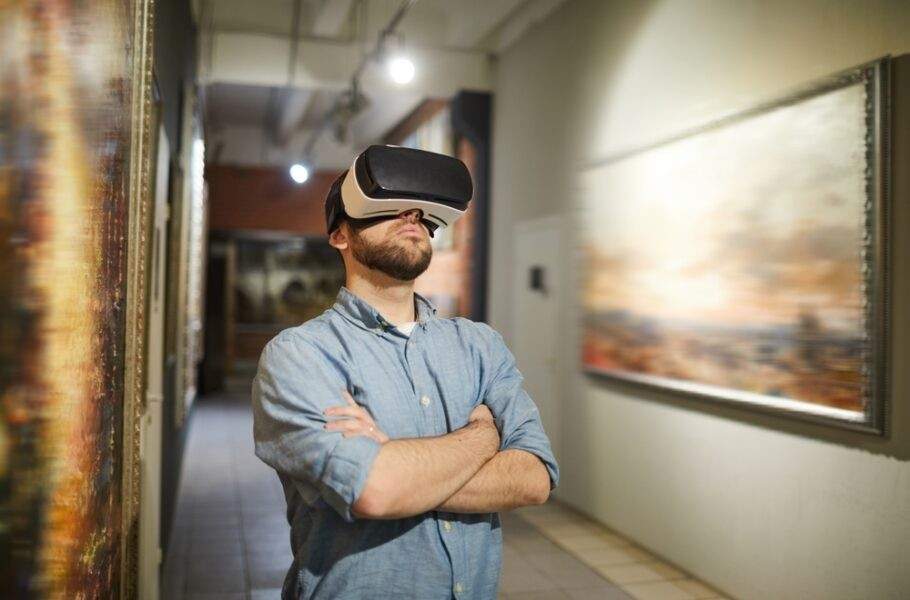
Sharjah Book Fair’s VR Experience Transports Visitors to Early Islamic Era
At the Sharjah International Book Fair (SIBF), history is no longer confined to pages. Visitors are embarking on an unprecedented virtual reality (VR) journey, stepping back 1,400 years to witness the dawn of Islam in the holy cities of Makkah and Madinah. This cutting-edge experience, developed by the cultural experts at Ana Al Madina, is more than a display of technology—it’s a profound educational portal to a pivotal era.
A Descent into Ancient Makkah
The experience begins as users don a VR headset and find themselves orbiting Earth before gently descending into a meticulously reconstructed 7th-century Makkah. They arrive in a city vastly different from today. The Kaaba stands at its heart, built from rugged stone blocks and surrounded by the pagan idols of the pre-Islamic era. The simulation is richly detailed: narrow alleyways lead to bustling open-air markets where traders barter and residents go about their daily lives. A narrative guide explains the social fabric of the time, detailing the culture, lifestyle, and the roles of women and children before Islam’s transformative message.
Witnessing Revelation and Transformation
The journey then guides participants to one of Islamic history’s most sacred sites: the Cave of Hira. Here, they witness the profound moment where the Prophet Muhammad (PBUH) received his first revelation from the Angel Jibreel (Gabriel). The visual realism is so compelling that many users instinctively reach out, feeling as if they can touch the cave walls themselves.
As the narration continues, the simulation depicts the rise of the early Muslim community and the subsequent transformation of Makkah. In a truly remarkable feature that would be impossible in the physical world, the experience allows users to step inside the Kaaba. They can gaze upwards at its golden interior lamps, offering a sacred perspective on this holy structure that few have ever seen.
The Madinah Chapter: Building a Community of Faith
The immersive journey continues in Madinah. Participants witness the Prophet’s Hijrah (migration), the construction of the first Masjid al-Nabawi, and a glimpse into his humble home. This segment vividly illustrates how the Prophet established a nascent society founded on the core principles of compassion, justice, and equality.
Dr. Adil Abdul Qadir, Manager of Ana Al Madina, emphasizes the project’s educational mission. “This VR set is designed purely for educational purposes. People who experience it understand what Makkah and Madina were like 1,400 years ago— the culture, the lifestyle, and the way people interacted.” He explains that the ultimate goal is to “connect people to faith through knowledge … not just to see history, but to feel it, to experience the values that shaped our world.”
An Emotional and Empathetic Connection
The impact of this VR experience on participants has been deep and moving. Many emerge visibly emotional, with some moved to tears, describing the sensation as feeling “real—as if they have truly travelled back in time.” Dr. Adil notes that this powerful response highlights the project’s success in evoking empathy and fostering a deeper understanding of the Prophet’s message of peace and unity.
By bringing this immersive experience to the Sharjah Book Fair, Ana Al Madina has crafted a powerful bridge between the present and the past. It is a testament to how modern technology can serve culture and faith. Participants don’t just watch a documentary; they inhabit the space, feel the significance of the events, and reflect on the human stories at the heart of Islamic history.
For anyone attending the SIBF, this VR installation is a must-see attraction. It stands as a powerful reminder that technology, when used with purpose, can be a gateway to empathy, cultural understanding, and spiritual reflection—proving that to understand our world today, we must sometimes have the opportunity to step into its past.

