


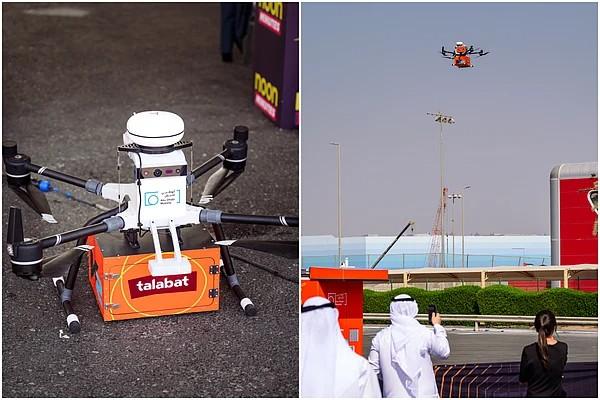
Drone Delivery Takes Flight in Abu Dhabi: Talabat & K2 Aerospace Launch New Service
Abu Dhabi is set to revolutionize its food and grocery delivery landscape through a groundbreaking partnership between government-owned K2 Aerospace & Technology and the leading delivery platform Talabat. The collaboration will introduce drone delivery services, transporting orders from Talabat’s cloud kitchens and partner restaurants to designated drop-off stations across the city.
How the Drone Delivery Service Works
The process is designed for simplicity and security. Customers will place their orders as usual through the Talabat app. Instead of a delivery rider, a drone will be dispatched to collect the order and fly it autonomously to a “Drop-Off Station” (DOS) located in a convenient urban area.
Upon arrival at the station, the customer will retrieve their order using a secure code, QR code, or password. “There will be just a code, a QR code or a password. It’s equipped… and you can get your food without getting it damaged,” explained Waleed Al Blooshi, Vice President of Strategy at K2.
Initially, the service will not involve drones landing directly at private homes or apartment buildings. The focus is on establishing a network of secure drop-off points. “For now we have a drop-off station and we will locate drop-off stations throughout Abu Dhabi,” Al Blooshi confirmed.
Ambitious Timeline and Current Testing
The service is moving from concept to reality at a rapid pace. Two drones are already undergoing live trials at the DRIFTx event during Abu Dhabi Autonomous Week at Yas Marina Circuit. This serves as a testing base for the partnership.
Once the formal agreement is signed between K2 and Talabat at the event, operational services could launch in “less than 45 days,” according to Al Blooshi.
Technical Specs and Climate Adaptations
The current proof-of-concept drones have a payload capacity of 10 to 20 kg and a flight range of approximately 5 to 10 kilometres. These specifications are expected to improve as the system scales. “This is just for the POC phase; Of course, we can make it larger, we can make it go further,” Al Blooshi noted.
A key consideration has been Abu Dhabi’s challenging climate. The companies have developed custom packaging solutions to ensure food quality is maintained during the drone flight, specifically engineered to withstand local heat and humidity.
Also Read: Etihad Rail to Link Directly with Dubai’s Al Maktoum International Airport
Navigating Regulations for Safe Skies
A primary challenge is seamless integration into Abu Dhabi’s airspace. K2 Aerospace is in active discussions with the General Civil Aviation Authority (GCAA) to ensure all operations comply with federal aviation regulations. “The first challenge is the air control… We have been talking with the GCAA… to see how we can manage, because not all drones can pass by and there are regulations,” Al Blooshi stated.
A Step Toward a Wider UAE Drone Ecosystem
This initiative is part of a broader national strategy to embrace autonomous delivery. In Dubai, the Dubai Civil Aviation Authority (DCAA) has announced an ambitious plan to have drone delivery cover 30% of the city by 2026 and 70% within five years. Abu Dhabi’s pilot program positions it at the forefront of this transformative shift in urban logistics.
For consumers, this means the future of delivery is fast approaching—faster, more efficient, and powered by innovation.

