


[ad_1]
A report by NBK said that the UAE’s economic growth in 2023 will slow from last year’s strong levels, but will still be fundamentally well supported by the country’s high-quality infrastructure and continued government reforms.
The bank’s Macroeconomic Outlook 2023-24 says Dubai’s real estate market is booming again, thanks to strong economic growth, rising immigration, tourism and overseas demand, although the rally may lose momentum by next year.
Downside risks include a weaker-than-expected global economy, tightening financial conditions, and a downturn in the housing market. Upside risks include higher-than-expected oil prices and improving trade-enhancing regional diplomatic relations.
Non-oil growth to slow after surge in 2022
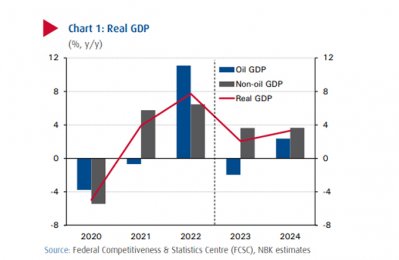
The UAE’s strong post-pandemic economic recovery will slow this year due to oil production cuts, a modest drop in oil prices, tightening financial conditions, a slowing global economy and a weakening boost from pandemic-era pent-up demand and the Dubai Expo.
Nonetheless, the country’s competitive advantage in the region, and gradual, pro-growth reforms under Strategy 2050 and Vision 2031 will continue to support fundamentals, while the authorities invest heavily in oil and gas production while also promoting energy transition (with a 2050 target of net zero emissions).
However, oil GDP overall will barely grow in 2023-24, in line with OPEC+ production cuts. This would bring oil production to 3.1 mb/d by the end of 2024, well below projected capacity of 4.3 mb/d (and possibly 5 mb/d by 2027), providing ample room for further increases. Meanwhile, gas production is expected to grow by 9% from the current level of 5.5 bcf/d by mid-2025, as the government aims to make the country self-sufficient in gas by 2030. Current natural gas consumption is about 6.7 bcf/d,
However, it is expected to rise in the coming years.
Non-oil GDP growth is dynamic, with 7.8% YoY growth in 1H22, the highest level since 2013, supported by a rebound in tourism and strong domestic demand, especially in trade, transport and hotels. PMI readings point to a slowdown in activity in 2H22, although the index remains firmly in the 54-55 expansion zone (above 50 = expansion) and domestic demand conditions remain firm. While some moderation in non-oil growth is inevitable this year given the above factors, we project a credible expansion of 3.6-3.7% in 2023 and 2024, down from an estimated 11-year high of 6.5% in 2022 . UAE Vision 2031 provides the government’s fundamental goals for the next decade, aiming to double the country’s GDP (to AED 3.0 trillion, implying an ambitious annual growth target of 7.2%), including Target for oil export, industry and tourism.
Dubai’s real estate market is booming again
Higher fuel and food prices and a recovery in housing rents push inflation to 4.8% in 2022. The central bank follows the Fed in raising policy rates by 475bps to 4.9% by mid-April 2023, which we expect – combined with more stable or lower fuel prices – to result in a 2.7% reduction in average inflation this year. A recovery in housing rents – which turned around last year after a four-year slump – poses a modest upside risk to inflation.
Meanwhile, rising borrowing costs are likely to weigh on credit to the private sector, which rose a modest 4 percent last year. According to CBRE, Dubai’s residential real estate market is booming, with record sales volumes reported in March 2023 and prices up 13% year-on-year, driven by a recovering economy and surging demand from abroad (DLD figures show price increases year-on-year 20%) by November 2022).
While growth is likely to slow, we believe demand in 2023 will be underpinned by high oil prices, increased immigration and tourism, the reopening of China to support overseas purchases, and possible easing of regional geopolitical uncertainty. The housing rally could run out of steam by next year, although the abundance of cash buyers in the recent boom suggests banks and the economy are less vulnerable if there is a downturn.
Strong medium-term fiscal position
Overall, public finances have held up well, with relatively small deficits in 2020 during the pandemic and large surpluses since then as oil prices and tax revenues have recovered.
Spending growth has also been contained, averaging only around 1% per annum in 2021-22, reflecting cuts in capital spending and the withdrawal of pandemic-related support. The federal budget, which accounts for about 15% of consolidated government spending, outlines a 7% increase in spending in 2023, which could signal a more expansionary stance from the government. However, even with a slight drop in oil prices in 2023, we expect a fiscal surplus of 6.9% of GDP.Revenue diversification will continue
A 9% corporate tax was introduced in June this year. The government holds an estimated $1.1 trillion in assets in its sovereign wealth funds (ADIA and Mubadala), providing a huge additional fiscal buffer.
The report also argues that the external current account will reach a massive 20% of GDP or more in 2023-24, benefiting from high oil prices and the government’s efforts to boost non-oil exports and double re-exports by 2030. surplus.
Global economic conditions pose risks
The UAE’s well-developed infrastructure, the government’s ongoing reform drive and initiatives to attract direct investment, as well as high oil prices support the economy’s medium-term outlook.Given Dubai’s role as a trade and investment hub, downside risks include a weaker global economy, the impact of rising interest rates on GRE contingent liabilities, and sharp
The domestic property market is sluggish.
However, it said there were upside risks from higher-than-expected oil prices, stronger global economic growth linked to the reopening of China, and improved regional diplomatic ties to facilitate trade. – trade arab news agency
[ad_2]
Source link

