


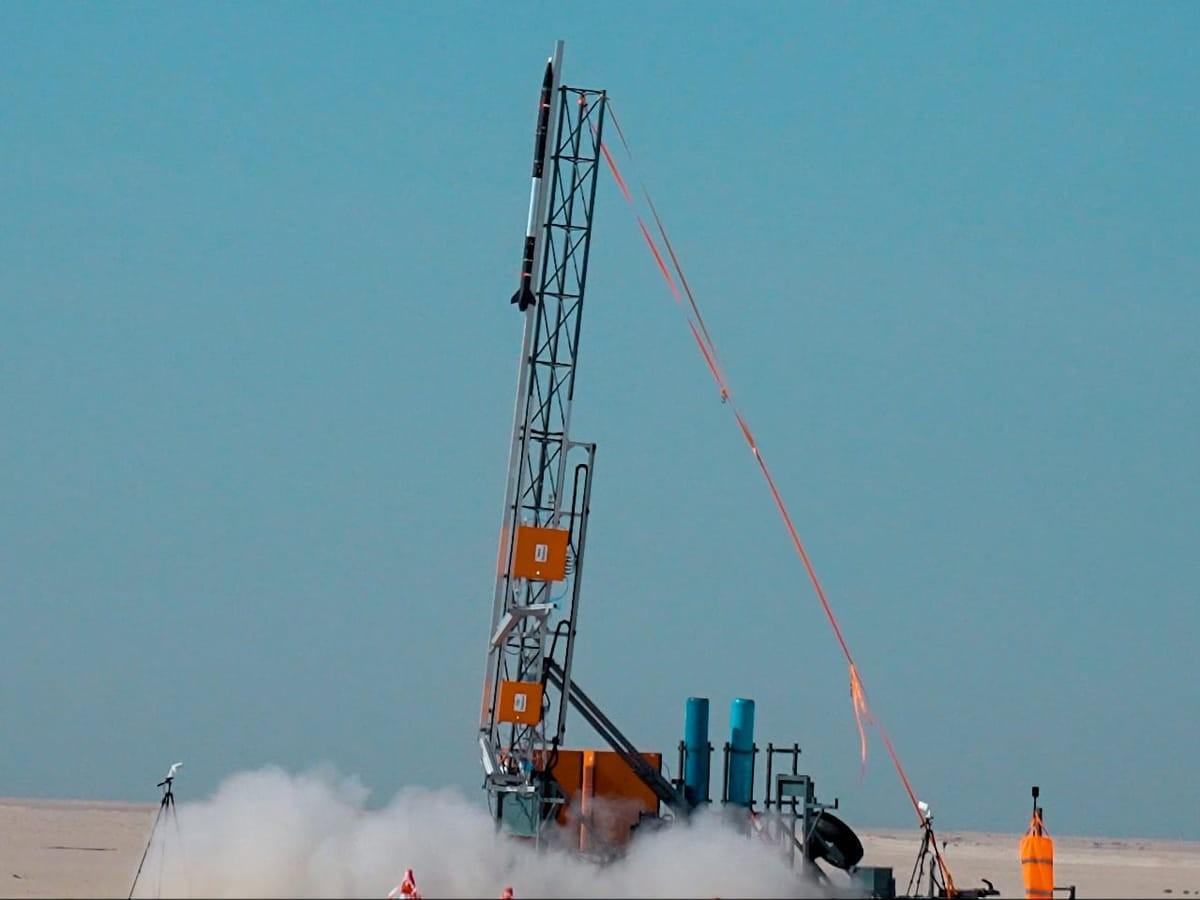
UAE Successfully Tests First Fully Homegrown Hybrid Rocket in Major Space Technology Breakthrough
Abu Dhabi, UAE — The United Arab Emirates has achieved a major breakthrough in its space technology efforts with the successful development and test flight of its first fully homegrown hybrid rocket — a project that took just over two years of intensive research, trial and error, testing and team building to come to fruition.
This milestone reflects not only a technical achievement but also the maturation of the UAE’s sovereign space and propulsion capabilities. The carefully executed initiative, led by the Technology Innovation Institute’s Propulsion and Space Research Centre, underscores the nation’s resolve to build complex aerospace systems using local expertise and manufacturing.
A Deliberate, Multi-Year Effort
From its inception, the rocket project was structured around a thorough roadmap and an intentionally diverse team of specialists, combining seasoned experts with fresh talent. “We put together experienced experts and young talent, and we established a clear roadmap,” said Dr. Elias Tsoutsanis, chief researcher at TII’s Propulsion and Space Research Centre.
The development process encompassed much more than designing and building a rocket. It required identifying suitable suppliers, ensuring they could produce precision prototype parts, establishing testing infrastructure, and refining manufacturing processes. In several cases, local manufacturers had to expand their capabilities to meet the demanding aerospace standards required for rocket components.
“The decision to proceed with local manufacturing ultimately paid off by enabling a fully locally manufactured system,” Dr. Tsoutsanis noted, highlighting how this approach has strengthened homegrown industrial capacity that can serve future aerospace projects beyond this single rocket.
The project team faced numerous challenges common to aerospace development: sourcing materials that could withstand extreme temperatures and pressures, developing manufacturing techniques for complex geometries, and ensuring quality control throughout the supply chain. Each obstacle required innovative solutions and close collaboration between researchers and industry partners.
Testing, Integration and Attention to Detail
A significant portion of the development phase was spent on extensive testing and simulation. Teams conducted repeated ground tests of the rocket motor, verified telemetry and control systems, and worked through multiple iterations of integration tests. “We had to design a very thorough test procedure with multiple iterations,” Dr. Tsoutsanis said, emphasizing that good simulations and lab trials were just part of what was needed before moving toward an actual launch.
System integration — the process of bringing together all individual components into a functioning whole — proved especially challenging. Control systems, sensors, hydraulics, and telemetry all had to work seamlessly in conditions that could not be fully duplicated in pre-launch simulations. Every subsystem underwent repeated verification and troubleshooting to ensure reliability, especially given the quick timing requirements for ignition and flight operations.
The hybrid propulsion system itself represented a complex engineering challenge. Combining a solid fuel grain with a liquid oxidizer requires precise control of flow rates, mixing ratios, and ignition timing. Too much oxidizer could cause instability; too little could result in insufficient thrust. The team’s careful calibration of these parameters ultimately proved successful.
The Launch and Recovery
On launch day, tension within the team was palpable. Engineers were still refining crucial software and telemetry code just two minutes before the countdown began. These final adjustments addressed last-minute data from pre-launch checks, demonstrating the team’s ability to work under pressure and make critical decisions in real-time.
Then, as the countdown reached zero, the launch platform fell silent, and the hybrid rocket ignited and soared into the sky in a meticulously planned flight. The moment represented the culmination of two years of intensive effort, with years of collective experience behind every team member involved.
The hybrid propulsion system — which combined a solid fuel with a liquid oxidizer — lifted the rocket to its target altitude before it separated into two sections at apogee. A parachute deployed between them, allowing both halves to descend safely back to Earth. Onboard cameras captured this moment, confirming successful staging and recovery that would enable detailed post-flight analysis.
Recovery was a critical phase of the mission, as retrieving the rocket intact allowed engineers to collect and analyze flight data, verify performance, and confirm that all systems behaved as expected. The successful return of both segments was a cause for celebration and relief among the engineers, who could now study the hardware that had just completed its mission.
Technical Significance of Hybrid Rockets
Hybrid rockets occupy a unique position in propulsion technology. Unlike solid rockets, they can be throttled and shut down controllably. Unlike liquid rockets, they are mechanically simpler and safer to handle. This combination makes them ideal for applications ranging from sounding rockets to potential future boosters for small satellite launches.
The UAE’s successful development of hybrid rocket technology positions the country to contribute to this specialized field and potentially develop applications for education, research, and commercial services. The data gathered from this flight will inform future designs and operational procedures.
Building Toward Future Capabilities
With this successful launch behind them, the team now looks ahead to future goals. Data gathered from this flight will inform the next phase of development, which aims to scale rocket designs to reach higher altitudes and carry larger payloads. Eventually, this could contribute to the UAE’s ambition of developing a domestic launch vehicle capable of orbiting small satellites — a critical step toward full independent access to space.
Such capability would place the UAE among a select group of nations with sovereign launch capacity, reducing dependence on foreign providers and enabling responsive, cost-effective access to space for national needs. Earth observation, communications, scientific research, and technology demonstration missions could all benefit from domestic launch options.
“This mission is a first step,” Dr. Tsoutsanis said. “Sounding rockets naturally evolve into boosters,” hinting at a long-term plan that aligns with the UAE’s broader strategic vision for space exploration and technology leadership. The country already operates Mars missions and has sent astronauts to the International Space Station; developing domestic launch capability represents the next logical frontier.
Implications for UAE’s Space Sector
The successful rocket test adds to the UAE’s growing portfolio of space achievements. Following the Emirates Mars Mission, the Rashid lunar rover, and the UAE Astronaut Programme, this propulsion milestone demonstrates that the country is building comprehensive space capabilities across the full spectrum of space activities.
For the Technology Innovation Institute, the project validates its approach to building research teams capable of tackling complex engineering challenges. The combination of experienced international experts and young Emirati talent creates a knowledge transfer pipeline that will serve the nation for decades to come.
Conclusion: A Foundation for the Future
The UAE’s first fully homegrown hybrid rocket represents more than a single successful flight. It demonstrates the country’s ability to conceive, design, manufacture, and test complex aerospace systems using local resources and expertise. It builds industrial capacity that can support future projects. It trains a generation of engineers in the demanding discipline of rocket development.
As the team analyzes flight data and plans their next steps, the broader UAE space community celebrates another milestone in the nation’s journey toward becoming a comprehensive space power. From Mars to the Moon to now homegrown rockets, the UAE continues to reach for the stars.
First homegrown rocket. Successful flight. A nation’s space capabilities reach new heights.

