



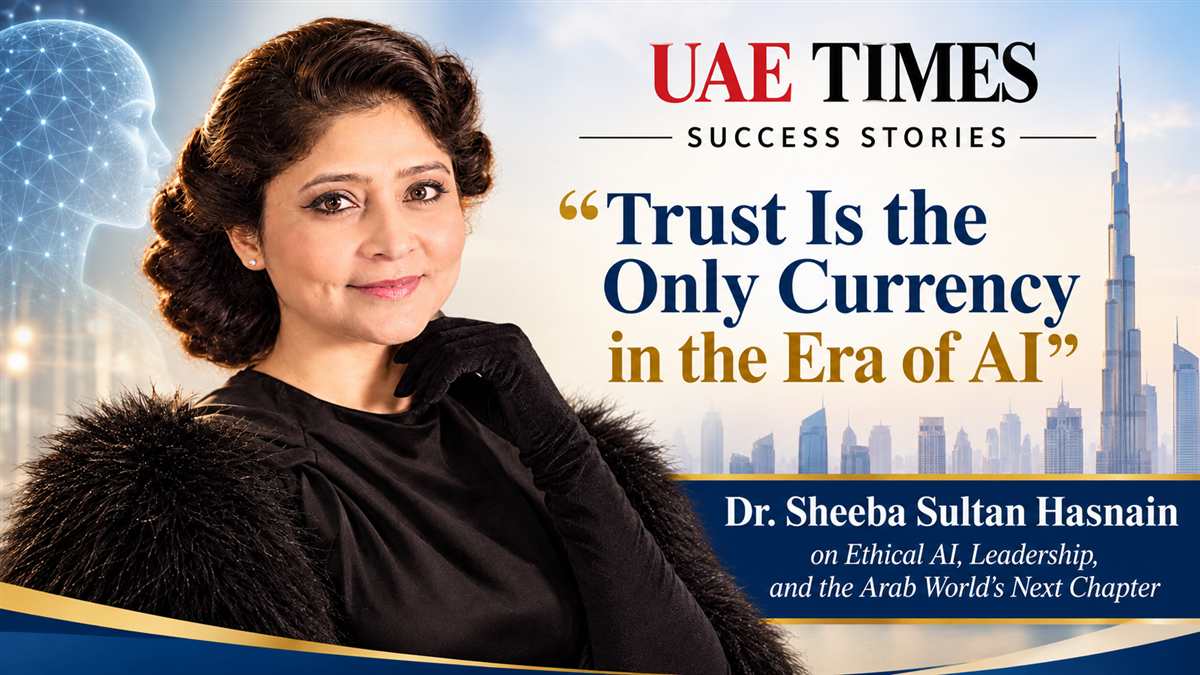
Dr. Sheeba Sultan Hasnain on Ethical AI, Leadership, and the Arab World’s Next Chapter
As artificial intelligence continues to reshape industries, redefine leadership, and influence critical decisions across the world, the importance of trust, accountability, and ethical governance has never been greater. While organisations race to embrace AI-driven innovation, the question of ensuring that technology serves humanity responsibly is becoming increasingly significant.
At the forefront of this evolving conversation is Dr. Sheeba Sultan Hasnain, Chief Executive Officer of Women Lead Conglomerate (WLC), Chairperson of the Board at Women in Ethical AI, and Chairperson of SENTIENTE FZE LLC. With more than two decades of experience spanning cybersecurity, enterprise technology, digital transformation, and responsible AI adoption, she has emerged as a prominent voice advocating ethical leadership in the technology landscape.
An accomplished author, Dr. Sheeba is the author of the Amazon No. 1 bestseller Ethical AI Leadership: Shaping AI That Serves Humanity. She was also recently recognised among the Top 100 Cybersecurity Leaders in the Middle East 2026.
Through Women Lead Conglomerate, she is working to bridge the gap between technological advancement and responsible leadership, bringing together industry leaders, innovators, and emerging talent to build a more accountable digital future.
In this exclusive conversation with UAE Times, Dr. Sheeba Sultan Hasnain reflects on her professional journey, the vision behind Women Lead Conglomerate, the growing importance of ethical AI governance, and the opportunities shaping the Arab world’s technological future.
What inspired you to become the CEO of Women Lead Conglomerate and focus your work on AI and leadership?
I did not begin in a boardroom. I began as a programmer and systems analyst, writing the code that other people depended on. From there, I moved into enterprise technology across the MENA region. In 2013, I joined the transportation sector within the Government of Sharjah, where I progressed from Head of Applications to Head of IT Operations and later served as a Senior PMO and Digital Transformation Specialist.
Across all these roles, I kept encountering the same problem in different environments: organisations delegate work, but they do not necessarily transfer judgment. Projects were delivered, systems went live, and yet everything continued to depend on a handful of people making the decisions.
Artificial intelligence raised the stakes of this challenge enormously. For the first time, machines are not simply performing tasks; they are executing decisions at scale. Consequently, questions about whose judgment, whose values, and whose accountability are embedded in these systems stopped being philosophical discussions and became operational necessities.
Driven by this conviction, Women Lead Conglomerate emerged as a platform that makes responsible innovation practical, translating ethics into governance, digital trust, and measurable execution.
Through initiatives such as Nurturing Trust: The Ethical AI Friday Series, where CIOs and C-level executives come together every month. The Global Ethical AI Congress, a pioneer gathering of leaders under community of Women in Ethical AI & Men in Ethical AI, and Coders Scouts, which introduces children to AI and technology ethics as a matter of community responsibility, we work across the entire spectrum, from the leaders making decisions today to the generation that will shape tomorrow.
What key obstacles and challenges have you encountered on this journey, and what lessons have you learned as a leader in the AI and leadership industry?
The first challenge was credibility. I spent years as one of the few women in deeply technical environments, and I learned early that vision must always be supported by evidence.
Make decisions, not just suggestions. Communicate your reasoning with confidence. Negotiate for scope, authority, and resources in proportion to the results you are expected to deliver.
The second challenge was transitioning from technical leadership to governance leadership. Solving a complex technical problem is satisfying because the system either works or it does not. Helping organisations make better decisions is considerably harder because the failures are often less visible, a value statement on a website that nobody can act upon, or a committee reviewing systems it does not fully understand.
That experience taught me the principle on which I now build everything: ethics that exists only in documents is not ethics; it is decoration.
Ethical AI defines intent, while responsible AI ensures execution. The real work lies in translating principles into clearly designated owners, refusal mechanisms, audit trails, and safeguards that remain effective even when the leader is not in the room.
The final lesson is personal. Protect your energy and your integrity. Choose long-term credibility over short-term approval. Trust is built through consistency, keeping your word, giving credit generously, and addressing difficult conversations directly. It is the only asset that truly compounds over time.
From your perspective, how is the AI and leadership sector evolving in the Arab world, and what major trends or transformations do you anticipate in the years ahead?
The Arab world, and the UAE in particular, has done something unusual: it treated AI as a matter of national strategy before much of the world began treating it as a matter of policy. That ambition is real, and the momentum across the region is extraordinary.
What I see now is the sector entering its second chapter. The first chapter was about adoption: pilots, proofs of concept, and excitement. The second chapter is about governance.
Boards are beginning to ask more challenging questions. The discussion is no longer simply, “Do we use AI?” but rather, “Who is accountable for what it decides?”
Global frameworks such as ISO 42001, the NIST AI Risk Management Framework, and the EU AI Act are reshaping expectations, and regional leaders are aligning with these developments rapidly.
Three transformations particularly stand out to me.
First, AI literacy is becoming a leadership skill rather than merely an IT skill. Executives can no longer approve technologies they do not understand.
Second, trust is becoming a competitive advantage. Organisations, and, frankly, nations: that can demonstrate their AI systems are governed responsibly will earn the confidence of regulators, customers, and investors.
Third, women in this region are moving from participation to decision-making authority. They are moving beyond simply being assigned more responsibilities to being entrusted with actual decisions and budgets. That shift, more than any technology, will define the next decade.
My belief is that the Arab world does not have to import its AI story. It can write its own and lead globally on the question every market is now asking: How do we make AI worthy of trust?
What are your long-term goals as CEO of Women Lead Conglomerate, and how do you envision contributing to the strategic growth of AI and leadership across the Arab region?
My long-term goal is simple to articulate but demanding to achieve: to make trust operational.
Through EthosVerse, our Ethical AI platform, we are working to transform trust from a slogan into an operating model—one that embeds accountability, transparency, and responsible governance directly into executive decision-making.
For Women Lead Conglomerate, our ambition is to develop the Global Ethical AI Congress into a world-class platform rooted in this region, continue equipping CIOs, CEOs, and senior leaders through the Ethical AI Friday Series, and expand Coders Scouts so that children across the region encounter AI first as creators and ethical thinkers, rather than merely as consumers.
As an author, Volume Two of Ethical AI Leadership is currently in production, taking these frameworks further into practical application and expected to launch at Global Ethical AI Congress, 7th Jan 2027 at Crowne Plaza Jumeirah, Dubai.
As a leader, however, I measure success not by the size of the platform but by what continues to function without me: leaders who make the right decisions independently, organisations whose values endure beyond their founders, and a generation of women who hold genuine authority rather than honorary positions.
UAE Times | The Road Ahead
Dr. Sheeba Sultan Hasnain’s perspective highlights an important shift taking place in the global technology landscape. As artificial intelligence becomes increasingly integrated into business operations, public institutions, and everyday decision-making, technological capability alone will not determine the leaders and organisations that shape the future. Accountability, ethical governance, and the ability to earn public trust will be equally important.
Her work through Women Lead Conglomerate reflects a broader ambition to position the Arab region not merely as an adopter of emerging technologies, but as an active contributor to the global conversation on responsible innovation. By bringing together senior executives, technology professionals, and younger generations, her initiatives seek to make ethical AI a practical leadership priority rather than an abstract principle.
As the UAE continues to strengthen its position as a global technology and innovation hub, voices advocating responsible AI leadership will play an important role in shaping the region’s next chapter.
Reflecting on the philosophy that drives her work, Dr. Sheeba leaves us with a powerful message:
“Trust is the only currency in the era of AI. It is not a slogan. It is a system, earned through clarity, governed by accountability, and sustained by the courage to choose what is right when it is hard. Building that system, for this region and beyond, is the work of my life.”
About Dr. Sheeba Sultan Hasnain
Dr. Sheeba Sultan Hasnain is the Chief Executive Officer of Women Lead Conglomerate (WLC), Chairperson of the Board at Women in Ethical AI, and Chairperson of SENTIENTE FZE LLC. She has more than two decades of experience in cybersecurity, enterprise technology, digital transformation, and responsible AI adoption. She is the author of Ethical AI Leadership: Shaping AI That Serves Humanity.

