


Mexico Plunges into Violence After Death of Cartel Boss “El Mencho” — Supermarkets, Banks and Cars Torched in Revenge Attacks
Mexico City, Mexico — Mexico has been rocked by a widespread and dramatic surge of violence after Mexican security forces killed one of the country’s most notorious drug lords, Nemesio Oseguera Cervantes, widely known as “El Mencho.” The leader of the powerful Jalisco New Generation Cartel (CJNG) was killed in a military operation in the western state of Jalisco on February 22, 2026, triggering an intense wave of coordinated retaliation by cartel members and supporters that has shaken several states and disrupted daily life for civilians and tourists alike.
The violence that erupted within hours of the announcement demonstrated both the cartel’s organizational capacity and the deep loyalty El Mencho commanded among his followers, raising fears that Mexico may be entering a new and particularly violent chapter in its long-running war against organized crime.
Killing of El Mencho and Immediate Aftermath
El Mencho — considered Mexico’s most wanted drug trafficker and one of the most powerful cartel figures in the country, with a multi-billion dollar empire spanning multiple continents — was killed during a security operation carried out by the Mexican army in Tapalpa, Jalisco. The military assault, which involved intense gunfire and clashes with cartel gunmen, left him mortally wounded. He later died while being transported by air to Mexico City, according to official statements from security officials who confirmed the death after forensic identification.
The CJNG, which El Mencho led for years, has been deeply involved in the production and trafficking of fentanyl, methamphetamine, heroin and cocaine, supplying vast quantities of drugs to the United States and other international markets. Under his command, the cartel became one of Mexico’s most influential and financially powerful criminal organizations, rivaling even the infamous Sinaloa Cartel and expanding its reach far beyond Mexico’s borders.
Within hours of the announcement of his death, violence erupted across numerous cities and states, demonstrating the cartel’s reach and the intensity of its members’ loyalty to a leader who had transformed them into a global criminal enterprise.
Cartel Retaliation: Arson, Blockades, and Chaos
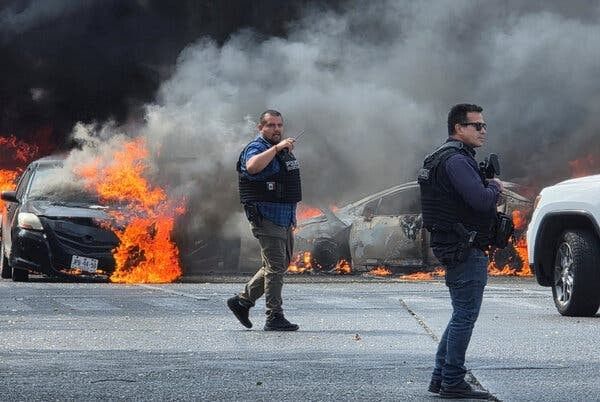
Across Jalisco, Guanajuato, Michoacán and other regions, alleged CJNG gunmen launched a series of coordinated retaliation attacks designed to paralyze daily life and send a message to authorities. Vehicles were set ablaze on highways, creating walls of fire that blocked critical transportation routes. Supermarkets, banks, petrol stations and other commercial establishments were torched, their owners and employees fleeing as armed groups moved systematically through commercial districts.
The chaos brought parts of the transport network to a standstill, with highways rendered impassable by burning vehicles and roadblocks made of trucks and buses. Flights to popular tourist destinations such as Puerto Vallarta were canceled as authorities struggled to assess the security situation and protect airports from potential attacks.
In some cities, armed groups even engaged security forces directly, attacking military police facilities and prompting authorities to suspend public transportation and urge civilians to stay indoors. In Guadalajara, Mexico’s second-largest city, major supermarket outlets and other stores were vandalized or set on fire, while smoke plumes rose over city districts, prompting fear and alarm among residents and visitors who found themselves caught in unprecedented chaos.
The coordinated nature of these attacks has led officials and analysts to describe the unrest as a revenge campaign by CJNG loyalists against the government and security forces following their leader’s death, a calculated show of force designed to demonstrate that the cartel remains operational and dangerous. Some analysts warn that, beyond retribution, deeper violence could unfold as internal factions within the cartel compete for leadership and influence in the power vacuum El Mencho’s death has created, potentially triggering a bloody succession war.
Civilians Affected and International Response
The violence has had immediate and severe effects on civilians and international travelers who suddenly found themselves in active conflict zones. Residents in affected zones have been advised to shelter in place, with authorities issuing emergency alerts through mobile networks. Schools have been temporarily closed in some cities, and businesses have shuttered as owners wait to see whether the violence will spread further.
Hotels and businesses in tourist regions have reported a sharp decline in activity amidst safety concerns, dealing a blow to local economies that rely heavily on tourism. Airlines like Air Canada, Aeromexico and others canceled flights to and from Pacific coast destinations due to the unrest, stranding travelers and disrupting vacation plans.
Governments of other countries, including the United States and Canada, issued travel advisories urging their citizens to avoid non-essential travel to affected regions and to remain cautious if already in Mexico, adding to the economic impact of the violence.
Political and Security Implications
Mexican authorities have defended the operation as a significant achievement in the long-running fight against organized crime, one they hope will weaken the CJNG’s grip on drug smuggling networks and disrupt its operations. President Claudia Sheinbaum and senior officials stressed that the country’s security forces carried out the operation independently, and highlighted El Mencho’s long history of violence and transnational criminal activity as justification for the high-risk operation.
However, the outbreak of violence underscores the risks inherent in targeting high-profile cartel leaders, a strategy that has produced mixed results throughout Mexico’s decades-long drug war. Past operations against cartel bosses — such as the 2019 capture and temporary freeing of Ovidio Guzmán of the Sinaloa Cartel, which triggered similar violence in Culiacán — have also led to violent backlash that endangered civilians and demonstrated the limits of state power in cartel-dominated regions.
The fear now is that the CJNG’s decentralised structure may adapt quickly to its leader’s death, leading to prolonged infighting and further instability as lieutenants vie for control of lucrative trafficking routes and production facilities. Some analysts predict a fragmentation of the CJNG into competing factions, each seeking to fill the vacuum left by El Mencho, which could actually increase violence in the short term even as it weakens the organization long term.
El Mencho’s Legacy
Nemesio Oseguera Cervantes rose from humble origins to become one of the world’s most wanted men, with the U.S. government offering a $10 million reward for information leading to his capture. His cartel pioneered new trafficking methods and expanded into dozens of countries, becoming a global criminal enterprise that laundered money through legitimate businesses and corrupted officials at every level.
His death represents a significant victory for Mexican and U.S. law enforcement, but the violence that followed demonstrates that criminal organizations adapt, and that killing leaders does not necessarily destroy the structures they built.
Looking Ahead
The coming days and weeks will determine whether the CJNG fragments, coalesces around new leadership, or manages to maintain cohesion despite its founder’s death. Each scenario carries different implications for Mexican security and for the civilians who find themselves caught between warring criminal factions and the state.
For now, the people of Jalisco and surrounding states shelter in place, waiting to see whether the violence will subside or escalate further. Schools remain closed. Businesses are shuttered. And a nation watches to see what comes next.
El Mencho dead. Violence unleashed. Mexico’s drug war enters a new and uncertain chapter.

