



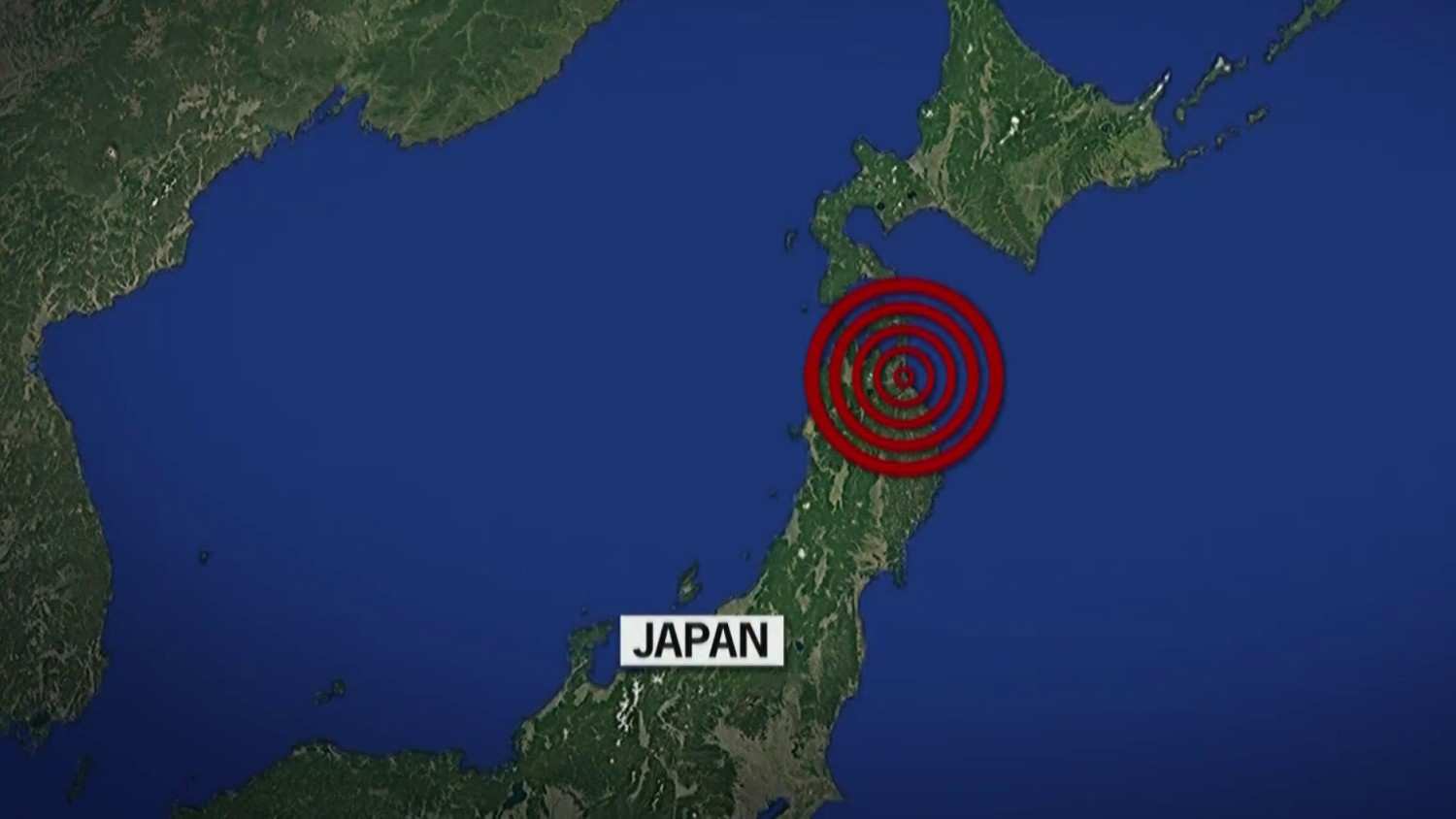
7.4 Magnitude Earthquake Hits Japan Near Sanriku Coast, Tsunami Warnings Issued
A powerful 7.4-magnitude earthquake struck off the northern coast of Japan on Monday, triggering tsunami warnings across parts of the country’s northeast as authorities urged residents to move to higher ground immediately. The tremor sent shockwaves across the region.
According to the Japan Meteorological Agency (JMA), the quake hit at around 4:53 pm local time in waters off the Sanriku coast. The epicenter was located at a shallow depth of about 10 kilometers beneath the sea, which increased concerns about possible tsunami waves reaching nearby coastal communities. Officials warned that waves of up to three meters could hit parts of Iwate Prefecture as well as sections of Hokkaido and Aomori. The shallow depth amplified the risk.
Public broadcaster NHK interrupted regular programming to issue emergency alerts, telling people living near the shoreline to evacuate immediately and avoid river mouths or low-lying coastal areas. Authorities stressed that tsunami waves can arrive more than once and may continue for several hours after the initial quake. Emergency sirens were sounded in vulnerable towns, while local governments activated disaster response teams. Evacuations were swiftly ordered.
The tremor was felt across a wide area of northern and eastern Japan, including Tokyo, where buildings swayed for several seconds. The quake registered an “upper 5” on Japan’s seismic intensity scale in some northern areas, indicating strong shaking capable of toppling unsecured furniture and damaging weaker structures. The shaking was widely felt.
Train services in parts of northern Japan were temporarily suspended as a safety precaution. Several sections of the Tohoku Shinkansen bullet train network were halted while engineers checked tracks and infrastructure for damage. Airports in the affected region also reported brief disruptions as officials assessed runways and terminals. Transport networks were put on alert.
Japan’s Prime Minister’s office quickly set up an emergency task force to gather information and coordinate response efforts. The government said it was closely monitoring coastal regions and preparing rescue services in case of flooding or structural damage. So far, there have been no immediate reports of major casualties, though officials warned that the full extent of the impact may not be known for several hours. The government is on high alert.
Residents shared videos on social media showing buildings shaking and people rushing outdoors as alarms sounded. Some footage also showed fishing boats leaving harbors to avoid potential damage from incoming waves, a common practice in tsunami-prone regions. Social media captured the panic.
Japan is one of the world’s most earthquake-prone countries because it lies on the Pacific “Ring of Fire,” where several tectonic plates meet. The country has one of the most advanced earthquake warning systems globally, capable of sending alerts to phones, television networks, and transportation systems within seconds of a quake being detected. Advanced warning systems saved lives.
Memories of the devastating 2011 earthquake and tsunami, which killed nearly 20,000 people and caused the Fukushima nuclear disaster, remain deeply rooted in Japan. Because of that tragedy, emergency responses to seismic events have become faster and more coordinated. Lessons from 2011 have been applied.
Also Read: Breakthrough Approval: UAE Clears Foundayo Oral Weight Loss Pill as GLP-1 Alternative
Officials have advised residents to remain away from coastal areas until all tsunami warnings are officially lifted. Emergency agencies continue to monitor wave activity and aftershocks, warning that additional tremors could follow in the coming hours. Stay away from the coast. Aftershocks are possible. Japan braces for what comes next.

