



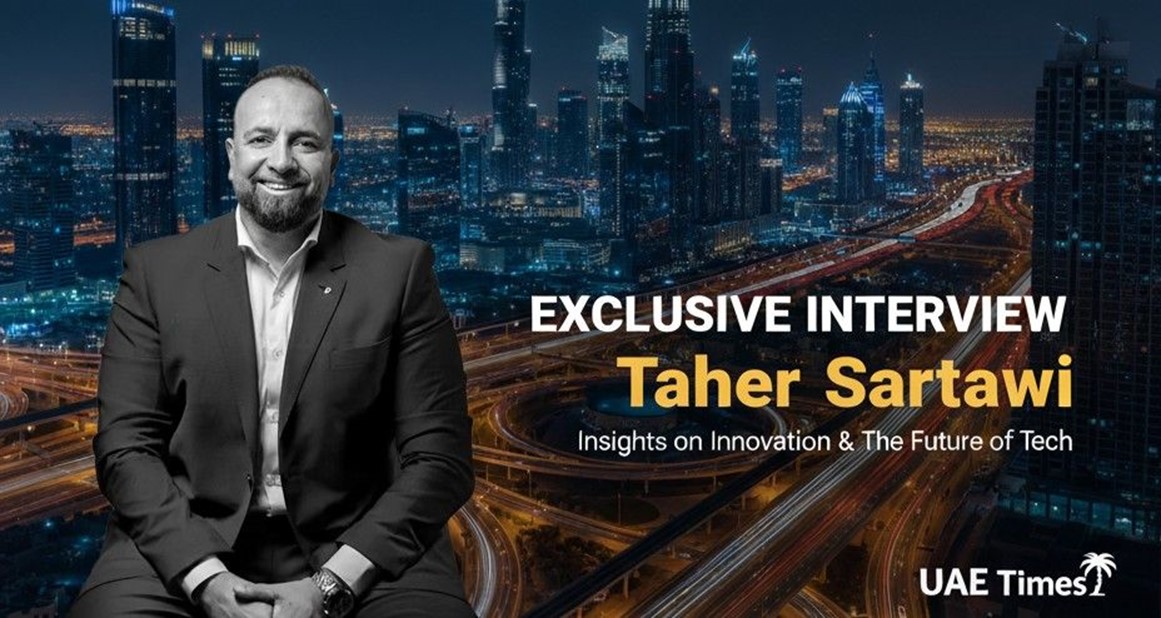
Engineering the Future: An Exclusive Interview with Taher Sartawi
In a rapidly evolving construction landscape, the MEP sector has become the silent force driving innovation, sustainability, and operational excellence across the UAE. To understand this transformation more closely, UAE Times sat down with Taher Sartawi, a forward-thinking industry leader known for his hands-on approach, technical depth, and commitment to future-focused engineering.
In this exclusive interview, Taher Sartawi shares insights on leadership, digital transformation, AI adoption, and the evolving expectations shaping modern MEP delivery. His journey reflects how passion, discipline, and a solutions-driven mindset can propel an engineer into becoming a transformative industry voice.
Taher Sartawi, What motivated you to embark on a career in your industry?
The MEP industry is the hidden backbone of construction. It is challenging because it must meet essential functional needs while maintaining minimal impact on architectural and structural intent—without compromising on technical performance. With my natural drive to take on challenges and my passion for practical, out-of-the-box solutions, I found that this industry fits me perfectly. In many ways, it didn’t just become my career—I feel the industry chose me.
What does a typical day look like for you?
A new day is a new opportunity—and it is structured in advance. My schedule is planned with clear priorities across work, business, and personal commitments. I begin by reviewing the day’s agenda and confirming the key decisions and actions required.
On the professional side, my focus is on core project matters: technical reviews, commercial coordination, stakeholder alignment, and ensuring continuity at site. I address issues early, maintain clarity among the teams, and ensure progress remains measurable and consistent.
In parallel, I manage business responsibilities and ongoing strategic follow-ups that support long-term objectives, not just daily execution.
Personal and family commitments are treated with the same structure and presence. Time is allocated intentionally—not left to chance.
The principle is straightforward: clarity in priorities, discipline in execution, and continuous forward movement across every aspect of life.
How is your industry evolving, and what trends do you foresee?
The MEP industry is evolving toward greater integration, efficiency, and sustainability. There is a clear shift from conventional, isolated execution to coordinated, data-driven systems that deliver performance, energy optimization, and long-term value.
Digital tools such as BIM coordination, 3D modeling, and asset information management now play a central role in early decision-making and the reduction of rework. In parallel, process automation—particularly in procurement workflows, cost control, and project tracking—is improving transparency and consistency. AI is increasingly used for predictive maintenance, material forecasting, and design validation, enabling faster and more informed decisions.
From the end-user perspective, luxury and comfort expectations are reshaping MEP delivery standards. In high-end residential and hospitality environments, there is greater demand for micro-zoned climate control, quieter air distribution, enhanced air quality, and seamless smart automation—comfort that is experienced, not operated. The engineering focus is shifting from “installing systems” to curating experience and well-being.
For those entering the field: Treat this industry as a long-term investment in knowledge. The fundamentals will always matter, but the way we design, coordinate, and operate systems is transforming rapidly. Learn to think in terms of integration, automation, and data-driven decisions. Become fluent in BIM environments, smart controls, and AI-assisted design—they will define how projects are delivered.
The engineers who succeed in the next era will be those who understand both how systems physically work and how information flows across the project lifecycle. Those who commit to continuous learning and forward thinking will find this industry full of opportunity.
Taher Sartawi. Can you share any pivotal career moments?
In an organizational context, pivotal moments arise when leadership has the courage to convert difficult challenges into strategic opportunities. These defining points often appear during market pressure or operational uncertainty, when stepping beyond the comfort zone becomes essential. Over the years, several moments shaped the company’s direction:
2008 – Navigating the Global Financial Crisis
During a period when many companies were withdrawing from projects, we did the opposite. We led with confidence, taking on opportunities that others were hesitant to approach. This strategy, combined with diversifying into essential public-sector projects such as schools, transport facilities, and utility-related developments, enabled the company to stay active and resilient when the market was at its weakest.
2015 – Expanding into Residential Towers and High-Rise Projects
This year marked our deliberate entry into the residential and tower sector, starting with mid-rise buildings exceeding ten storeys. Adding this segment expanded our technical depth beyond traditional MEP fit-out works and positioned the company to compete in more complex and demanding developments.
2020 – Steering Through the COVID-19 Pandemic
With funding challenges, stalled sales, supply-chain disruptions, and suspended projects across the market, this period tested every part of the construction industry. We maintained disciplined progress on our projects, explored alternative solutions to overcome constraints, and increased the volume of smaller secured works to ensure healthy cash flow. This phase strengthened our systems and reinforced our commitment to consistent delivery despite external pressure.
2022 – Entering Large-Scale Villa Communities and Horizontal Developments
A major strategic milestone was entering the world of mass-villa construction with multiple clients. Managing large community developments—reaching up to 650+ villas delivered within three to four years—added horizontal construction and large-scale logistical coordination to our portfolio. This expansion elevated our capabilities and broadened our operational expertise significantly.
These pivotal moments collectively shaped the company’s identity—turning challenges into opportunities, expanding our technical reach, and reinforcing a culture of resilience and adaptive leadership.
Taher Sartawi, How do you define your leadership style?
I define my leadership style as structured, decisive, and performance-driven, with a strong focus on systems, planning, and accountability. Leadership begins with setting clear direction, establishing disciplined processes, and ensuring every team member understands their priorities and responsibilities.
Humility is also an important part of my approach. I trust my team leaders and give them the space to operate, take ownership, and lead with confidence. I avoid micromanagement, yet I remain connected by periodically diving into the details—not to replace anyone’s role, but to stay aligned, support critical decisions, and reinforce standards.
As I always tell the team during company gatherings: “I am always here, as long as you are doing your part.”
My philosophy is straightforward: trust the team, trust the process, and run detailed checks from time to time. This balance maintains discipline and clarity while empowering people to deliver with consistency and confidence.
What are your long-term goals for your career or business?
“By 2030:
Every day should advance the company forward improving on yesterday and preparing to be stronger tomorrow. This includes learning from our mistakes, enhancing overall performance, and consistently elevating the quality of our work. Our direction focuses on structured growth, stronger internal systems, and disciplined project delivery, while fully utilizing digital transformation tools and support—automation, data-driven processes, and AI—to enhance clarity and efficiency.
We aim to strengthen our reputation and position the company as a well-known and respected brand in the MEP industry, while expanding into new sectors such as oil & gas and marine-related MEP fields. We also remain committed to developing the next generation of leaders and increasing our involvement in public service projects that support our cities and contribute to the nation.
Ultimately, the long-term goal is to build an organization that is stable, scalable, and forward-thinking—one that delivers with discipline, adapts confidently to future challenges, and continues to grow with purpose.
CONCLUSION – UAE Times
Taher Sartawi ’s perspective reflects a new era of leadership in the UAE’s MEP sector—one driven by innovation, accountability, and a future-ready mindset. His commitment to technology, sustainability, and people-first leadership demonstrates how the industry is moving beyond conventional engineering toward smarter, integrated, and experience-centric solutions.
As the UAE positions itself as a global leader in sustainable construction and digital transformation, leaders like Taher Sartawi are shaping the blueprint for the next decade of engineering excellence.

