



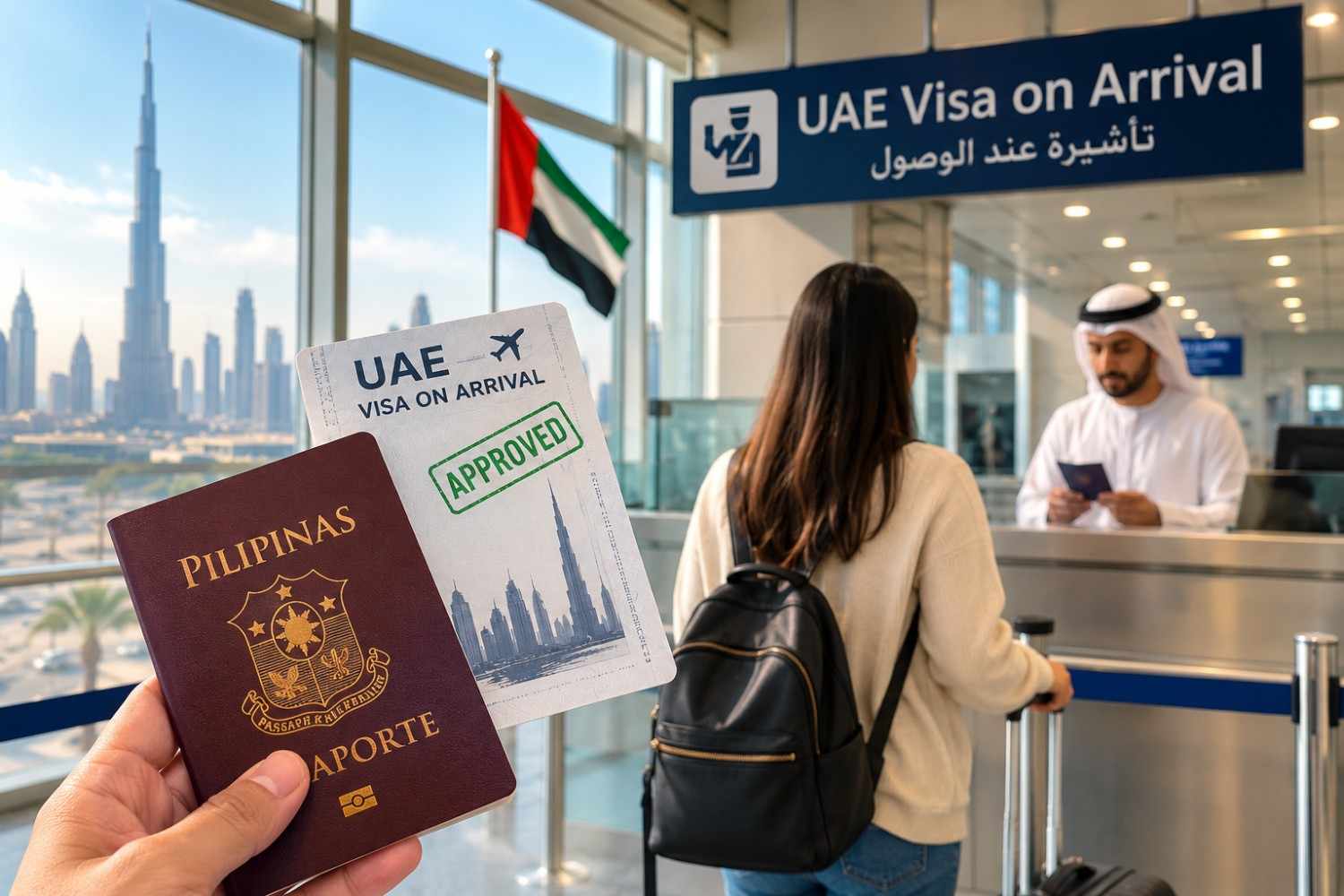
UAE Visa on Arrival for Filipinos Starts Today: Eligibility, Fees and Rules
The UAE officially started offering visa on arrival for eligible Filipinos on June 25, 2026 — no advance application needed if you qualify. Here is everything you need to know, including what actually happens when you land.
What Is the UAE Visa on Arrival for Filipinos?
Starting June 25, 2026, Filipino citizens holding valid visas, residence permits, or Green Cards from select countries can get a UAE visa stamped right at the airport — no pre-arranged visa, no waiting for email approval, no travel agency needed.
This was confirmed by the Philippine Department of Foreign Affairs (DFA), which called it a reflection of the “excellent bilateral relations between the Philippines and the UAE.”
This is a big deal for the roughly 660,000 to one million Filipinos living and working in the UAE, and for family members visiting from abroad who already hold foreign residency.
Who Is Eligible for the UAE Visa on Arrival?
You are eligible for the UAE visa on arrival only if you meet all three conditions below:
✅ Condition 1: You Hold a Philippine Passport
You must be traveling on a valid Philippine passport — not another nationality’s passport.
✅ Condition 2: You Have a Valid Document from an Approved Country
You must hold at least one of the following, issued by an approved country. The document must be active — not expired or pending renewal.
| Approved Country / Region | Accepted Documents |
|---|---|
| United States | Valid visa or Green Card |
| Canada | Valid visa or permanent residency |
| Australia | Valid visa or permanent residency |
| United Kingdom | Valid visa or residence permit |
| European Union (any member state) | Valid visa or residence permit |
| Japan | Valid visa or residence permit |
| South Korea | Valid visa or residence permit |
| Singapore | Valid visa or residence permit |
| New Zealand | Valid visa or residence permit |
Condition 3: Your Documents Are Valid for at Least 6 Months
Both your Philippine passport and your supporting foreign visa/permit must have at least 6 months of validity remaining from your date of arrival in the UAE.
If your US visa, for example, expires in 3 months — you do not qualify. Plan accordingly
UAE Visa on Arrival Fees
| Visa Option | Fee (AED) | Approx. Fee (PHP) | Extendable? |
|---|---|---|---|
| 14-Day Visa | AED 100 | ₱1,550 | Yes — once only |
| 14-Day Extension | AED 250 | ₱3,875 | — |
| 60-Day Visa | AED 250 | ₱3,875 | No |
Which Option Should You Choose?
- 14-day visa — Best for a quick family visit, layover extension, or short holiday. If your plans might stretch, apply for the extension before it expires (not after).
- 60-day visa — Best for longer stays: family reunions, tourism, or business trips. Pay once and forget it. Just remember it cannot be extended under any circumstances, overstaying results in fines.
What Actually Happens at the UAE Airport
Here is what to expect when you land. The whole process typically takes 10 to 20 minutes if the queue is short.
Step 1 — Do NOT queue at the regular visa-on-arrival counters.
Look for UAE immigration counters that handle visa-on-arrival processing. In Dubai (DXB), these are located in the arrivals immigration hall. Ask an airport staff member if you are unsure.
Step 2 — Have these documents ready in hand:
- Your valid Philippine passport
- Your valid foreign visa, Green Card, or residence permit (physical card or printed copy; digital may not always be accepted)
- Return or onward flight ticket (recommended)
Step 3 — Inform the immigration officer you are applying for a visa on arrival.
State clearly whether you want the 14-day or 60-day option.
Step 4 — Pay the fee.
Payment is collected at the counter. Have AED cash or a card ready. Confirm the accepted payment methods on arrival, as this may vary by port of entry.
Step 5 — Biometrics and passport stamp.
Standard UAE immigration procedure: fingerprints and iris scan. Your visa is then stamped in your passport.
Step 6 — You’re in.
Proceed through to baggage claim and exit. The whole process typically takes 10–20 minutes if the queue is short.
Pro tip: Carry a physical printed copy of your foreign visa or residence permit. UAE immigration officers may not accept digital-only versions, and it avoids unnecessary delays.
Documents Required for UAE Visa on Arrival
- Philippine passport valid for at least six months beyond your UAE arrival date
- Foreign visa, Green Card, or residence permit valid for at least six months beyond your arrival date
- Physical printed copy of your supporting document (do not rely on digital only)
- Return or onward flight ticket booked before departure
- AED cash or card ready for visa fee payment at the airport
- Decision made between the 14-day and 60-day option before you board
Important Rules Travelers Should Know
- Visa validity starts from date of entry.
- Overstaying results in fines.
- Employment is not permitted.
- Immigration officers have final approval authority.
- Travelers may be asked to show proof of accommodation and onward travel.
FAQs
Can I get the visa on arrival if my US visa expires in four months?
No. Your supporting document must be valid for at least six months from your UAE arrival date. If it falls short, apply for a regular UAE tourist visa in advance.
Does this apply to Filipinos living in the Philippines who have a valid US tourist visa?
Yes — as long as that visa has at least six months of validity remaining, you qualify regardless of where you currently live.
Do I need an OEC to use this?
No. OEC requirements apply to OFWs departing for employment. If you are traveling as a tourist or visitor, OEC is not required.
Can I work in the UAE on this visa?
No. The visa on arrival is a visit entry only. Working on a visit visa is illegal in the UAE.
Is this available at all UAE airports?
Yes, the policy covers all UAE ports of entry including Dubai, Abu Dhabi, Sharjah, and others.
Can I enter Dubai with this visa on arrival?
Yes. The policy applies across all UAE entry points, including Dubai, Abu Dhabi, Sharjah, and other emirates.

