



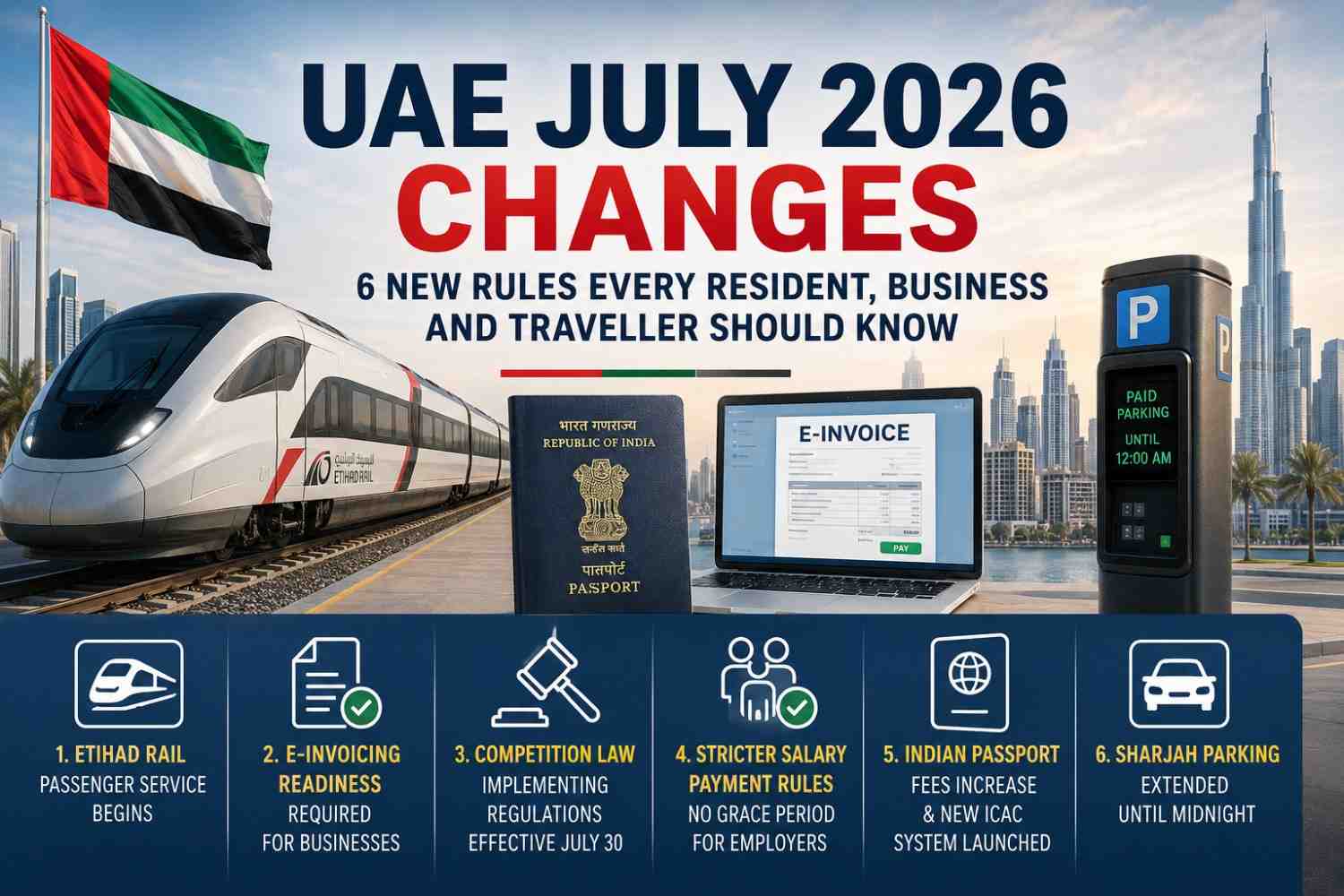
UAE July 2026 Changes: 6 New Rules
The UAE July 2026 Changes bring several important updates that affect residents, businesses and travellers across the country.
From the launch of the long-awaited Etihad Rail passenger service to new business compliance requirements, revised salary payment rules and higher Indian passport fees.
July marks one of the busiest months for regulatory and infrastructure changes in recent years. Here’s a look at the six key developments everyone should know.
Etihad Rail Passenger Service Begins
After years of planning and construction, Etihad Rail welcomed its first passengers on June 30, with bookings for the Abu Dhabi–Fujairah route opening fully from July 1.
According to the operator, more than 10,000 tickets were sold before the official launch. Travellers can now book tickets through the Etihad Rail website and mobile app.
The launch marks the first phase of the UAE’s passenger rail network. Additional stations and routes are expected to open in stages as the wider national rail project continues to expand over the coming months.
Businesses Enter a New Digital Reporting Era
July 1 also marks an important milestone in the UAE‘s digital transformation as businesses begin preparing for the country’s e-invoicing framework.
Companies are expected to start integrating their systems with government-approved service providers in preparation for the nationwide rollout. The initiative aims to improve tax reporting, reduce errors and streamline financial transactions across the private sector.
Another significant business change follows later this month. On July 30, the Implementing Regulations for the UAE’s Competition Law come into effect, requiring companies with significant market power to comply with updated competition and anti-monopoly rules.
Private-Sector Salary Rules Tighten
Private-sector employers are now required to pay employee salaries on time under stricter enforcement of the Ministry of Human Resources and Emiratisation’s wage regulations.
Under the updated rules, salaries covered by the Wages Protection System (WPS) must generally be paid by the due date, replacing the previous 15-day grace period that many employers relied upon.
Certain exceptions continue to apply, including cases involving wage disputes, employees reported as absconding, or workers under judicial restrictions. However, businesses that fail to comply may face escalating penalties.
Indian Passport Fees Increase
Indian nationals living in the UAE are now paying higher passport application fees following revisions that took effect on July 1.
The changes coincide with the launch of the new Indian Consular Application Centre (ICAC) system. Under the new arrangement, Alhind Tours and Travels LLC has become the official provider for passport, visa and document attestation services, replacing multiple service providers that previously handled these applications.
| Passport Type | Previous Fee | New Fee |
|---|---|---|
| 36-page Passport (Regular) | Dh285 | Dh450 |
| 60-page Passport (Regular) | Dh380 | Dh630 |
| 36-page Passport (Tatkal) | Dh855 | Dh900 |
| 60-page Passport (Tatkal) | Dh950 | Dh1,080 |
Sharjah Extends Paid Parking Hours
Drivers in Sharjah should also be aware of updated parking rules.
From July 1, paid parking in yellow-signboard zones now operates until midnight. The change extends paid parking hours in selected areas where evening parking was previously free after certain hours.
Motorists are advised to check parking signage carefully to avoid fines.
What the UAE July 2026 Changes Mean
Together, the UAE July 2026 Changes reflect the country’s continued focus on digital transformation, stronger regulatory compliance and improved transport infrastructure.
Whether you’re a resident, employer, business owner or frequent traveller, understanding these updates can help you avoid penalties, stay compliant and make the most of new services now available across the UAE.
| Change | Effective Date | Who’s Affected |
|---|---|---|
| Etihad Rail passenger bookings | July 1 | Commuters and travellers |
| E-invoicing readiness | July 1 | Businesses |
| Competition Law Implementing Regulations | July 30 | Companies with significant market power |
| Stricter salary payment rules | Enforced from June | Private-sector employers and employees |
| Indian passport fee revision and ICAC launch | July 1 | Indian nationals in the UAE |
| Sharjah paid parking extended until midnight | July 1 | Sharjah motorists |
FAQs
What are the biggest UAE July 2026 changes?
The biggest updates include the launch of Etihad Rail passenger services, e-invoicing readiness for businesses, stricter salary payment rules, revised Indian passport fees, Competition Law regulations and extended paid parking hours in parts of Sharjah.
When did the new Indian passport fees take effect?
The revised passport fees came into effect on July 1, 2026, alongside the launch of the new Indian Consular Application Centre (ICAC) system.
Who is affected by the new salary payment rules?
The updated rules apply to private-sector employers and employees covered under the Wages Protection System (WPS), with stricter enforcement for delayed salary payments.

